The Moon That Owed Us Rain
Page 32 of 212
Chapters
“You can verify the readings,” Istra said. “You can’t override the freeze from this panel.”
“I’m not here to override anything,” Sella replied. “I’m here to understand the limits before my council decides whether to contest them formally.”
“And if they do?”
“Then I argue that the city has standing to challenge a release that determines whether its wards function.” She glanced toward the pressure map. “I’m not asking you to ignore your survey.”
The answer was less comfortable than a threat. Istra had prepared herself to refuse a demand, not to hear a commissioner describe the boundaries of her authority without pretending the boundaries were convenient.
The engineers confirmed the shell’s present readings. They also found that the city’s projected water requirement assumed the factory membrane line stayed active. If it shut down, the hospital would lose access to replacement filters within a month. If it stayed active, the factories would consume the same trunk that the wards needed. The city had a shared line because, decades earlier, the builders had designed one route for all of Ninewells’ water.
“There isn’t a hospital branch?” Tem asked.
“There are internal branches,” Sella said. “They all begin after the collector. The charter draw fills the shared trunk first.”
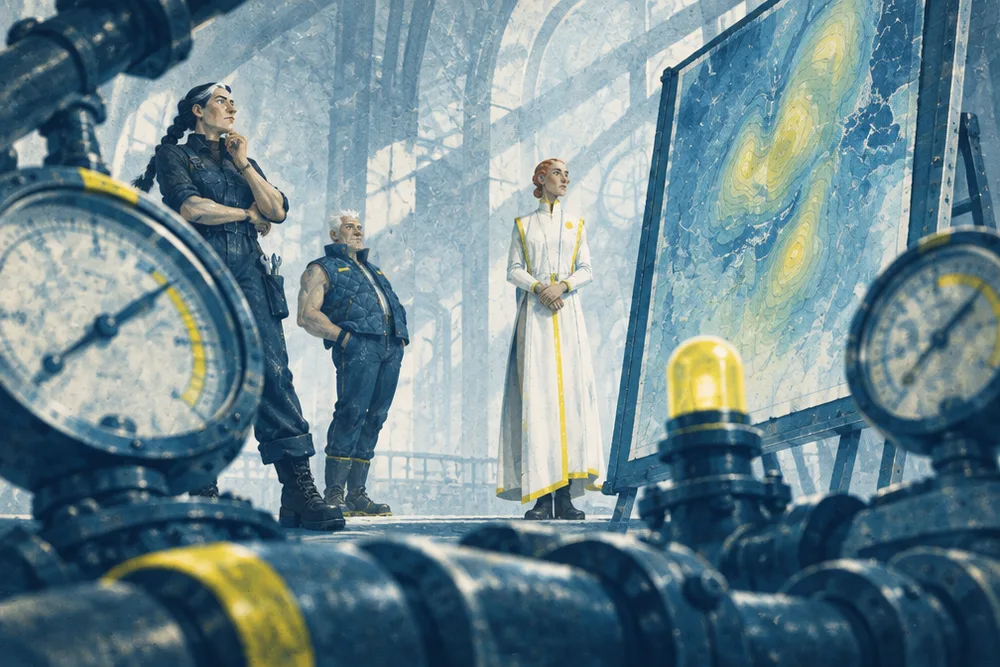
Istra looked at the route on the display. Ninewells’ hilltop collector sat at the head of the original network, a funnel that intercepted every flow meant for the lower plain. She remembered the promise in the release order: first draw to the city, then distribution by charter. In the old map, the villages downstream were small dots and the moon was an empty reservoir. In the lived system, the city’s trunk was a gate.
“Could the hospital be supplied by a separate pulse?” she asked.
“Not without changing the routing,” one engineer said. “The collector takes the flow before the internal branch can meter it.”
“And the city’s factories?”
Sella answered. “They would go dry if the collector were bypassed.”
No one in the room seemed surprised. The consequence had been there all along, concealed by the clean line on the charter diagram. Istra wrote the finding beside the evacuation count.
Sella read the corrected evacuation schedule without sitting down. “Forty-two before the crossing. How many can stay in the dock galleries?”
“Not all of them,” Tem said. “The dock is a work space, not a settlement. We can make room for the most exposed residents during the reversal, but moving everyone there would block access to the service ring.”