The Moon That Owed Us Rain
Page 2 of 212
Chapters
Istra stepped outside. Rain was climbing from the village. It rose from the empty cistern lip in bright beads, from the damp dark seams between paving stones, from a cooking pot left to soak beside a doorway. The drops made no sound when they struck the undersides of eaves. They simply lifted, drifting up in a slow, uneven veil. Against the hard blue sky, their paths looked like scratches in glass.
She pressed her thumb against the gauge’s exposed sensor and read its tiny mechanical tremor. The dial stayed dead, but a frequency ran through the brass case: three short knocks, a pause, then one long. Istra knew that rhythm. On the ground it was too faint to hear, but Latch’s return beacon had used the same sequence during service tests. The beacon was signaling from orbit. And the water was answering it.
Istra ran to the beacon post at the eastern edge of the terraces. Its housing was squat and sun-bleached, bolted to a concrete plinth that had cracked during the last dry season. Reedstep had kept it working because the old landing network was all that remained of the village’s claim to the sky. The lamp was dark. She put her ear to the post and heard the pulse again through its metal skin: three knocks, pause, one long.
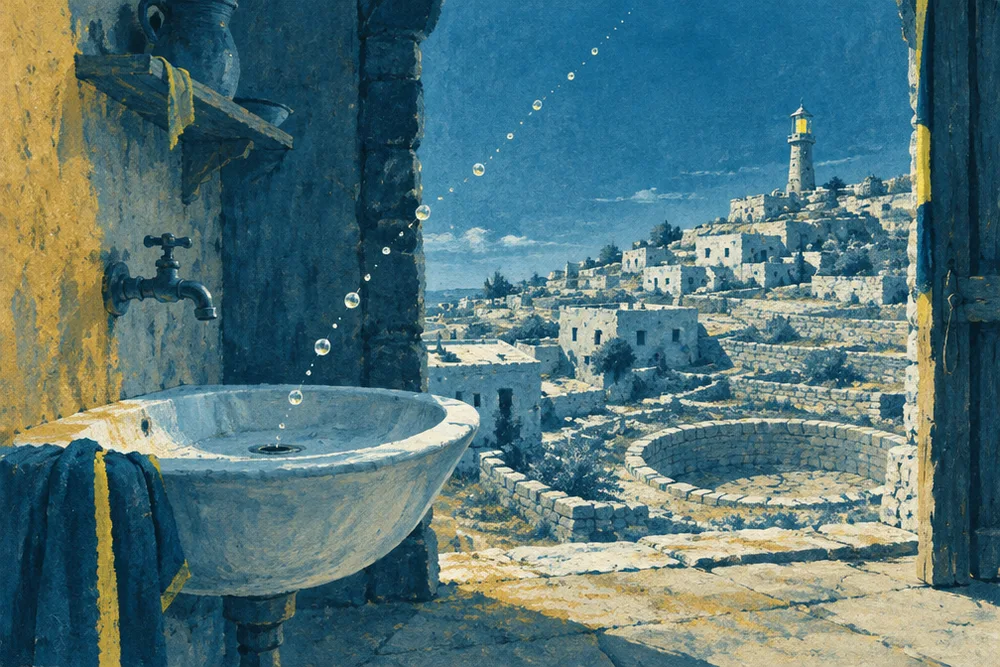
She fetched the service key from the post’s locked drawer and opened the plate. Dust, wiring, a coil wrapped in faded insulation. She set her portable meter across the contacts. The needle jerked in time with the signal. Above the rooftops, water continued its patient ascent. It was not falling from cloud, not yet. It was being pulled from the ground, from the pipes and basins, as though the whole dry basin had become a spring pointed toward the moon.
Latch hung low enough in daylight to look like a small, pale flaw against the sky. Istra had serviced its gauges once, years ago, when the artificial moon was still treated as a machine and not a place anyone needed to consider. Its return field had been designed to gather and retain water during the drought. The field should have remained dormant until a release was authorized. A signal like this meant the return system was drifting, or failing, or both.
She wrote down the pulse interval and the meter’s response. Then she made herself look at the people watching from their doorways. No one was asking what a return field did. They were watching the water leave their world. Istra knew the difference between being frightened and being useful; she had spent too many years pretending the second could excuse the first. She folded the service sheet, sealed it in a waterproof sleeve, and started for the municipal office.