The Moon That Owed Us Rain
Page 199 of 212
Chapters
Tem’s gaze rested on her signature at the top of the page. “That’s different from calling it a debt to the villages. The system owes a route. We don’t know yet who is owed what.”
Istra considered the distinction, then amended the heading: UNCONFIRMED DELIVERIES—REVIEW REQUIRED. Under it, she kept the outstanding list. The labels did not heal the harm, but they prevented the record from lying about it.
On the radio, Orri reported that the carts had reached the first road junction. He had no word from Hushfield yet, and Claycross had sent back only a beacon flash. Reedstep’s cistern level had fallen slightly as the cart tank filled. Orri gave the amount without complaint, then asked that the figures be published with the next queue.
“They’ll be,” Istra said.
“Not just the totals,” Orri replied. “The hours left. The failed calls. The places you don’t know about.”
“Yes.”
The channel clicked shut. Istra entered the request in the register. It was not an instruction she had authority to refuse. That was the point. The next queue would begin with the villages left dry, but it would begin with their own readings, not with an assumption made from the city’s map.
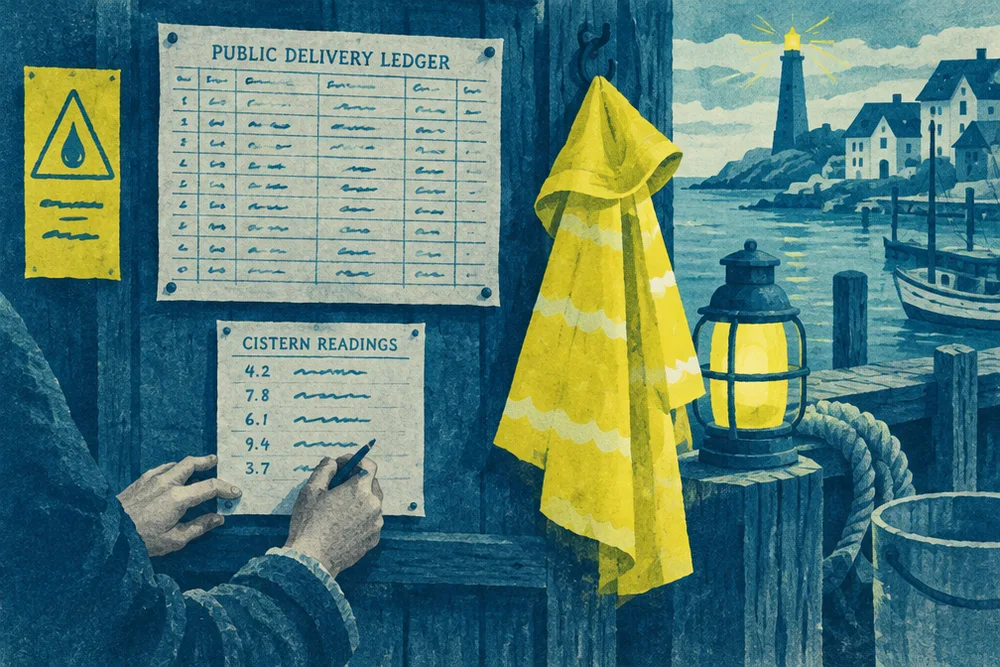
They took the register to the public board outside the dock, where the residents could read it without asking Istra for permission. The board had once held evacuation notices and maintenance warnings. Now the new sheet covered both, its edges held by four bolts. Tem added the relocation plan beneath it. The closed gallery appeared in red pencil, with a line drawn through the old passage.
People gathered in small groups, reading in silence or sounding out the village names. One man asked why Ninewells appeared twice. Istra explained: once for the hospital branch, once for the city’s factory trunk, which had been isolated before the crossing. He stared at the two entries, then at the blank lines for the villages. “So the city gets a record even when it gets nothing, but we don’t know whether we got anything.”
“That’s why the blanks stay visible,” Istra said. “Until we know.”
“You could make the page say more.”
“I could. It wouldn’t be more true.”
The man shook his head and went back to the list.
A resident brought a household notebook with water marks measured over a doorframe. Another brought a strip of cloth knotted at the level of a cistern’s old fill. Tem asked them to copy the dates and readings, not hand over the objects. He said a record that belonged only to the mechanic would be another kind of empty room.