The Moon That Owed Us Rain
Page 173 of 212
Chapters
Istra checked the route diagram. The line reached Reedstep. It did not tell her whether the ground receiver had caught the pulse, whether water had entered the cistern, or whether the beacon had gone dead after its trial. The system was doing its part with perfect indifference.
“The valve is requesting the next pulse,” Tem said. He pointed to a yellow prompt on the panel. CONTINUE TO MAINTAIN ROUTE.
The sentence blinked in lemon, then vanished and returned. It had been designed for an automatic sequence: open, deliver, repeat. A machine’s interpretation of persistence. The output interval had been written into the old charter model as a smooth draw, not the separated pulses Tem had proved necessary. If Istra accepted the prompt, the valve would keep feeding the line while the shell was still recovering.
“It will retry if the route doesn’t acknowledge,” Sella said. She looked at the unlit box, then at the blinking instruction. “How many times?”
“Until the sequence times out,” Istra said. “Or until we stop it.”
Tem’s needle quivered. The strain reading began to rise, slight but unmistakable. The storm pressed at Latch from outside, and the valve asked for more.
Istra’s palm tightened around the lever. There was no alarm yet. No red lamp, no warning shriek, only the soft insistence of a prompt written by people who had believed the system would always know what to do next. The gauge needle moved one hair’s breadth higher.
“Cut the route,” Sella said. “We can retry after the storm passes.”
“If I cut it now, we lose the crossing.” Istra watched the green Reedstep lamp. “The field won’t reverse again until the next orbital window.”
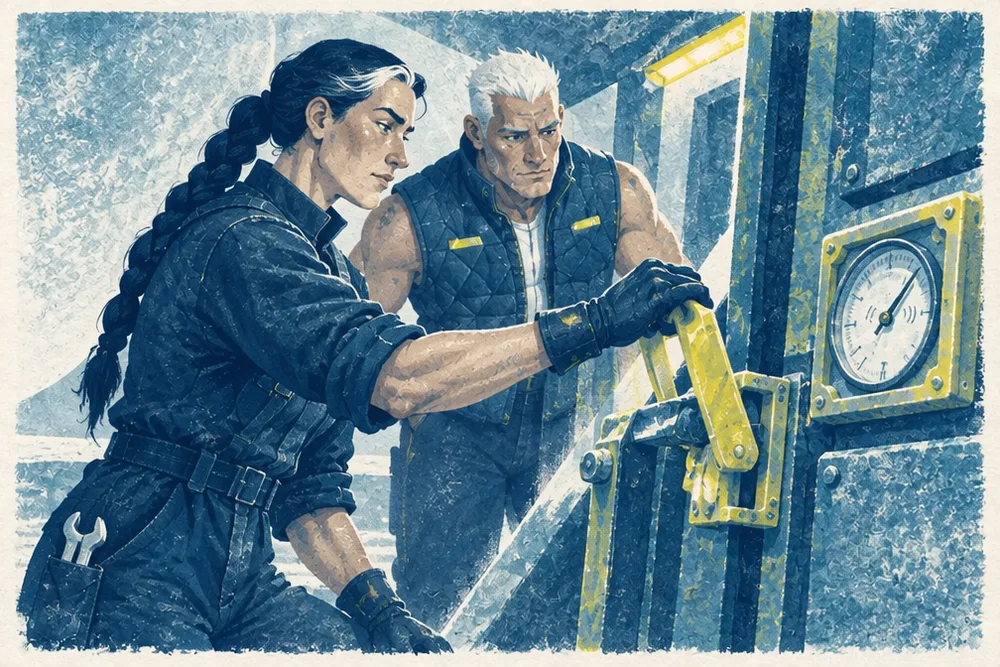
“If you don’t cut it, the shell may fail before then.”
“I know.”
The answer came out too quickly, almost a rebuke. Istra forced her fingers to loosen. She was not the only person in the room who understood the cost. Sella had shut off the factories. Tem had measured the galleries where families lived. Neither of them could make the decision in her place, and neither should have to carry it for her.
The communication panel hissed. A tiny flicker crossed the acknowledgment box—not a signal, just the lamp reacting to the storm. Sella leaned toward it. The box went dark again.
“No confirmation,” she said.
“Not yet.”
“The route may be wrong.”
“It may.”
“And the next pulse could be the one that opens the seam.”