The Moon That Owed Us Rain
Page 152 of 212
Chapters
He passed her the list. She scanned the familiar surnames and the newer ones, people who had settled after the drought years and never appeared in the maintenance records. She wrote a note beside each group: head count confirmed, temporary space needed, return route closed. The lines did not make the dock more comfortable, but they kept the residents from becoming an estimate again.
A burst of static interrupted the quiet. The operations channel carried a brief report from the orbit station: storm track rising faster than predicted, return-field instability increasing. The message repeated twice, each copy more broken than the last. Istra wrote the time in the margin and circled it.
“The crossing?” Tem asked.
“Still at dusk. Maybe sooner if the field slips.”
“Then the timetable is already wrong.”
“Yes.” She slid the report under the pressure chart. The shell had held a pulse, not a storm. Their paired readings were useful because they showed recovery time mattered more than discharge volume alone, but the test load was smaller than what they would need to release. A conservative interval would reduce the risk of collapse. It would also reduce the rain that could reach the villages before dawn.
Tem leaned back against the wall. “We could open a second valve.”
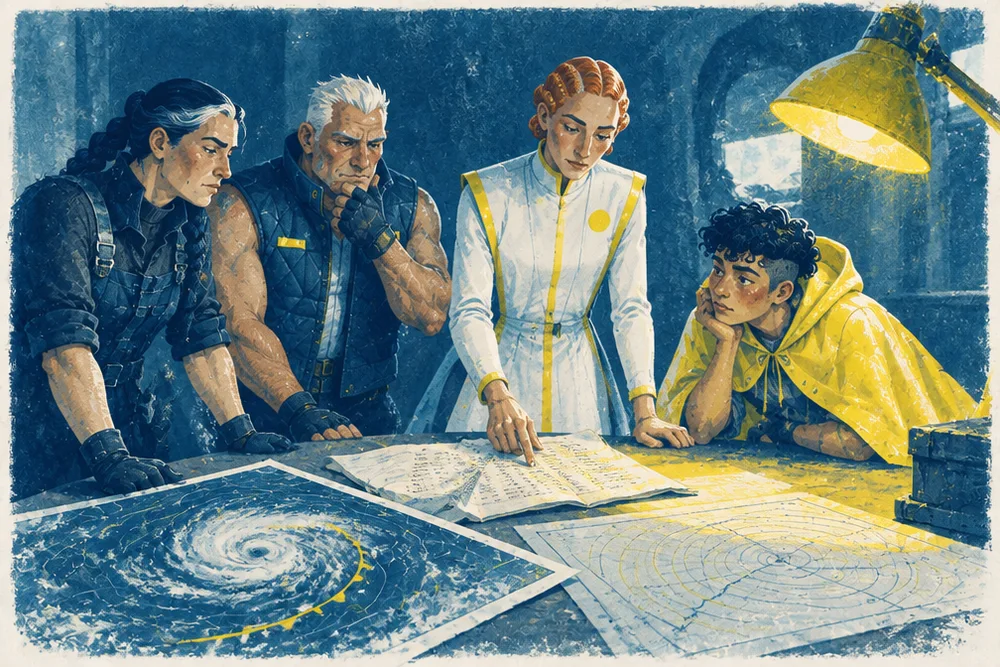
“Not until we know where it leads and what pressure it puts on the shell.”
“The old route?”
“The one on the map?” She met his eyes. “No.”
He accepted that without another argument. The dock’s crowded platform was the cost of the survey’s failure made immediate and visible. Istra closed the chart cover, then reopened it to add the storm report. Every time she wanted the numbers to look settled, the machine supplied another reason not to trust a neat line.
Istra went to the upper gauge station to compare the test shaft against the shell’s outer ring. The passage climbed through a narrow equipment stair, its handrail worn smooth where generations of mechanics had gripped it. At the landing, the station window showed the moon’s inner skin: a curved expanse of blue-black panels stippled with salt-grain mineral deposits. Beyond the glass, the storm’s faint sheen dragged upward across the surface.
The outer-ring needles sat in their brackets, each with a paper tag tied around its stem. Several were old enough that the ink had faded to gray. She checked the readings against the dock logs and found the same slow rise, but not the same rate. The storm was loading the shell unevenly, concentrating pressure near the test shaft.