The Moon That Owed Us Rain
Page 116 of 212
Chapters
Istra understood that this was not an evasion. It was the shape of the bargain: Ninewells could give up a privilege, but could not claim authority over the homes it had spent decades leaving off the map. The residents had to consent as people, not as a mechanical condition to be checked.
She climbed into the waiting lift with the tube against her ribs. The city’s noise dwindled beneath the grated floor: cart wheels, a bell from the hospital quarter, the intermittent knock of the repair crew’s hammer. Above, the sky looked blank and dry.
The launch ascent jolted through Istra’s knees. She kept one hand on the tether bar and the other on the waterproof tube. When the lift cleared the atmosphere, Ninewells shrank to a pale knot around its hilltop collector, the city’s pipes invisible from this height. The artificial moon crossed above it, a dark curve with a narrow rim of reflected light.
Istra had spent the trip down rehearsing a way to present the conditions without making them sound like another demand. Tem would hear the word audit and remember the vacancy certificate, the official map that had erased a settlement. The residents would hear binding and imagine outsiders given the power to reopen unsafe galleries. She had no phrase that could guarantee they would not hear an echo of the old harm.
At the docking collar, a lamp blinked lemon against the dark. The entry hatch opened with a shiver of pressure. Inside, the air smelled of damp mineral salt and the smoky oil Tem used on the survey gauges. Beyond the hatch, the dock’s metal deck bore fresh scuffs from families who had moved up from the exposed gallery. Their bedding and water jars were stacked in careful rows along the wall.
Tem stood at the far end, barrel chest under his quilted sleeveless coat. He leaned back on his heels, silver brush cut catching the overhead light. “The hearing took longer than you said.”
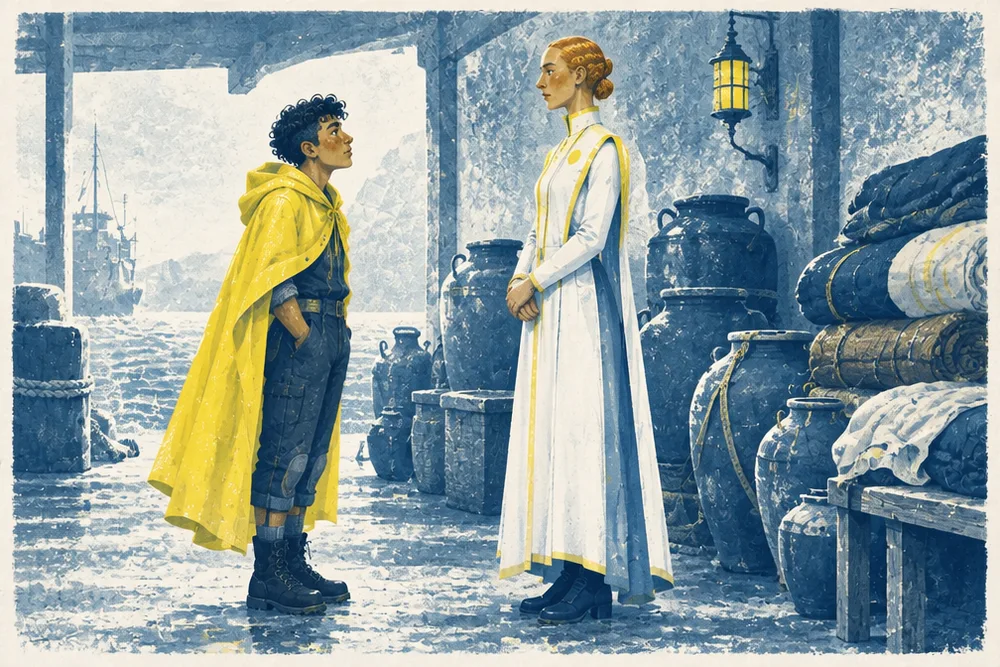
“The workers demanded a vote.”
“And?”
“They voted to consent, conditionally. Sella has not surrendered the key. She needs the residents to accept public, binding delivery audits.”
Tem’s split lower lip pressed flat. “Binding in what way?”
“Every pulse, every acknowledgment, every cistern reading goes in a public register. The city, villages, and residents can compare the readings. But no auditor can order a release against strain gauges, and residents hold the pause key.”
Tem looked past her at the stacked jars. In the dock behind him, an old woman was tying a child’s mattress into a bundle. Their home was somewhere inside the marked region of the shell, a region Istra’s paperwork had called empty.