The Moon That Owed Us Rain
Page 104 of 212
Chapters
“Provided the first delivery arrives.”
“Provided,” Istra agreed.
Orri had gone quiet. He stood by the wall, one hand resting on the old pipe as if to feel whether it still carried water. “Then we make sure the first delivery is measured, and the first reading is public.”
Istra looked at Sella. The commissioner’s expression offered neither assent nor refusal. But she had kept the factory gate locked, brought the old branch back into service, and watched the test to its end. The city had a route now. It also had a clock.
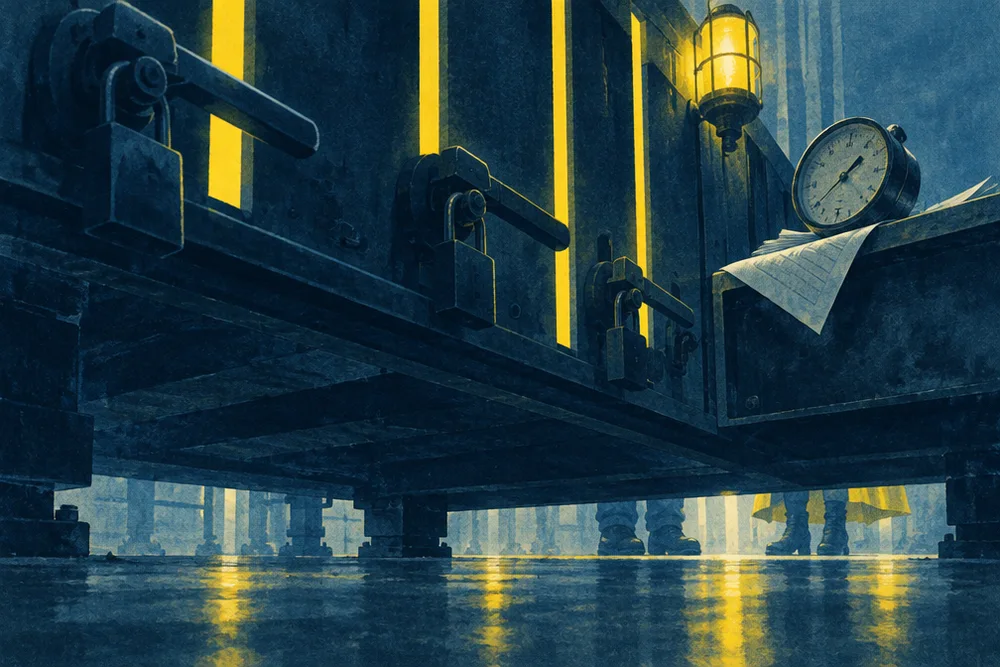
They returned to the service chamber to find two factory representatives waiting by the isolation board. One wore a stained work jacket; the other carried a folded payroll sheet. The stopped machinery had reached them faster than any official notice.
“You shut the feed without a vote,” the man in the jacket said to Sella. His eyes flicked toward Istra. “Is this the mechanic who’s going to take our water?”
“No,” Istra said. “I’m the mechanic who’s trying to keep the moon from breaking while it sends any water at all.”
The second representative unfolded the payroll sheet and held it out. “If the factories lose wet service, there are shifts we can’t run. If shifts stop, wages stop. People don’t eat promises about a future queue.”
Sella accepted the sheet, but did not look away from them. “This isolation was for a test. The ward branch passed. The factories will have to negotiate a reduced service if the city relinquishes the charter priority.”
“You’re speaking as though that’s settled.”
“It isn’t,” Sella said. “But the hospital has a viable independent route. That changes the terms.”
Istra felt the temptation to step between them and explain the lunar mechanics, as if pressure contours could make a wage vanish less painfully. She kept her hands at her sides. The factory representatives were not an obstacle she could tighten with a wrench. Their losses belonged in the account, alongside the collapsing shell and the villages that had never been named in the city ledger.
“The test proves a village-sized share reaches the ward,” she said. “It does not prove the city can keep every factory running. You deserve the schedule and the numbers before anyone asks you to agree.”
The man in the jacket studied her face. “And if the schedule says we get nothing?”
“Then that’s what it says. We’ll have to argue over it in daylight, not disguise it as a technical failure.”