The Laundromat Where Clocks Go Missing
Page 71 of 213
Chapters
Mara Sedge lived in a narrow house above the canal road, where the hill’s old stone steps gave way to a strip of municipal pavement. Vela went in the gray morning with the stub zipped inside her smock and a photocopy of it folded in her pocket. The original stayed at the laundromat, beneath the clear plastic and a tin of spare keys. She had begun to understand that carrying one piece of proof everywhere was another way of losing it.
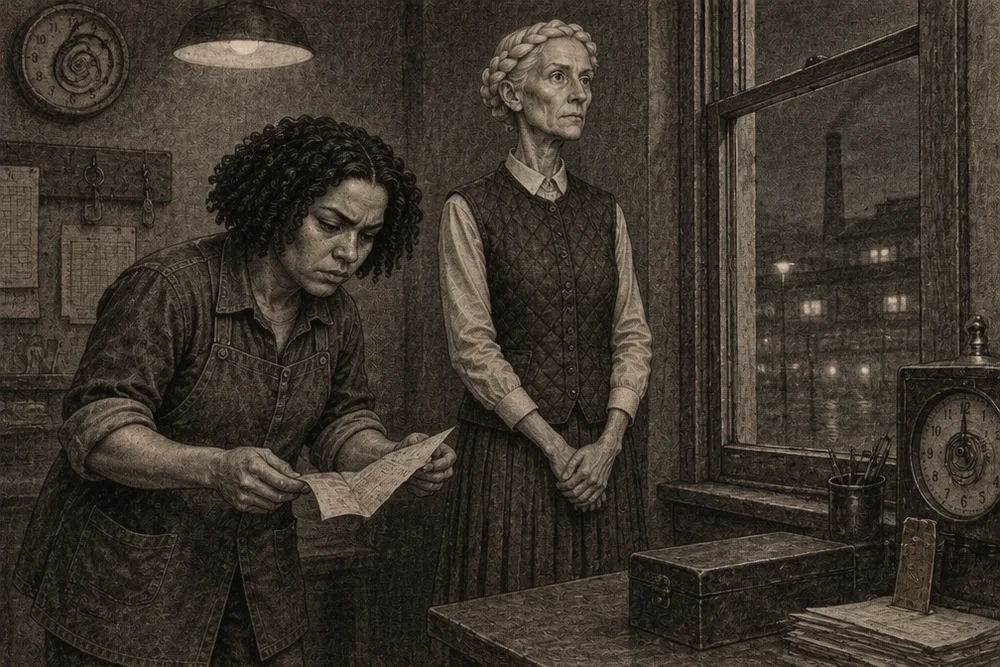
The front door opened before Vela could knock a second time. Mara was tall and thin, her spine so straight it seemed to hold the doorway in place. White hair braided in a crown sat tight against her head. Her quilted vest was buttoned to the throat over a pleated skirt, and her wrists looked almost fragile where she gripped the edge of the door.
“You’re Vela Crenwick,” she said. It was not a question.
“Yes. I work nights at the washhouse.”
“I know where you work.” Mara looked past her, down toward the canal and the mill roofs beyond. “Come in. You’re blocking the step.”
The front room was spare and clean, with a radiator ticking under the window. On its mantel sat a glass dish filled with buttons, most of them the dull brass color of old coins. Vela took the photocopy out but kept it folded. Mara watched her hands rather than her face.
“I found a pay stub,” Vela said. “From the settlement accounts. It has your punch mark.”
Mara’s gaze sharpened. “Where?”
“In the mill.”
“That building is condemned.”
“I know.”
“Then you know better than to go through its fence.”
Vela let the reprimand sit between them. “The stub records a brass payment against my flat. The public roll says the mill closed with cash wages and the housing sold outright. But this says someone counted credits toward rent.”
“Paper says many things.”
“Did you make this?”
Mara did not answer immediately. She went to the window and adjusted the blind by one slat. The canal’s surface showed between the houses, dull gray and broken by a passing barge. “I was a pay clerk,” she said. “For the last shift.”
“Then you can tell me what it means.”
“I can tell you what the town recognizes.”
“That isn’t the same thing.”
“No,” Mara said. “It isn’t.” She turned back. “Show me the mark.”
Vela opened the photocopy on the mantel. She had enlarged it at Kit’s office until the paper looked grainy, the punch holes black and blunt. The stub’s narrow columns survived the copying: flat, amount, date, drawer. At the bottom, a row of little circles made by the hand punch. One pair almost touched; the third sat farther away.