The Laundromat Where Clocks Go Missing
Page 62 of 213
Chapters
“Is that Rusk?” she said.
Ivo leaned in to look. The shape did not move. The dryer turned. The person disappeared behind the rim, then came around again with the next revolution.
“Maybe,” he said.
“You told me nobody else could cross.”
“I said people and objects can.”
“That’s not the same as saying nobody would be there.”
“No.”
She felt the stub through the pocket of her smock. It was flimsy paper and already warm from her body. But it had a number, a mark, a date, and her flat’s address. It was the first thing she had held that did not depend on Ivo’s account of events or Rusk’s claim of ownership.
The clock face still read 2:17. The laundromat beyond it looked a little farther away than before.
“Move,” Vela said.
They crossed the threshold together. The floor returned beneath Vela’s feet, smooth concrete with the drain grate at her left heel. The laundromat’s lights buzzed overhead; the detergent sign trembled once and settled. The air smelled of soap, wet fabric, and the stale heat of the dryers.
The dryer door clanged shut behind them. Vela stumbled against the machine and caught herself with one hand. Ivo reached for her shoulder, then stopped short. She took a breath, then another. The skin on her forearms prickled, as if she had come through a cold room, though the back row was warm.
The wall clock clicked past the minute. Her wristwatch had started again at 2:17 and jumped forward to 2:25. Dryer twenty-four was on its final turn. Its rumbling slowed into a tired, uneven rotation.
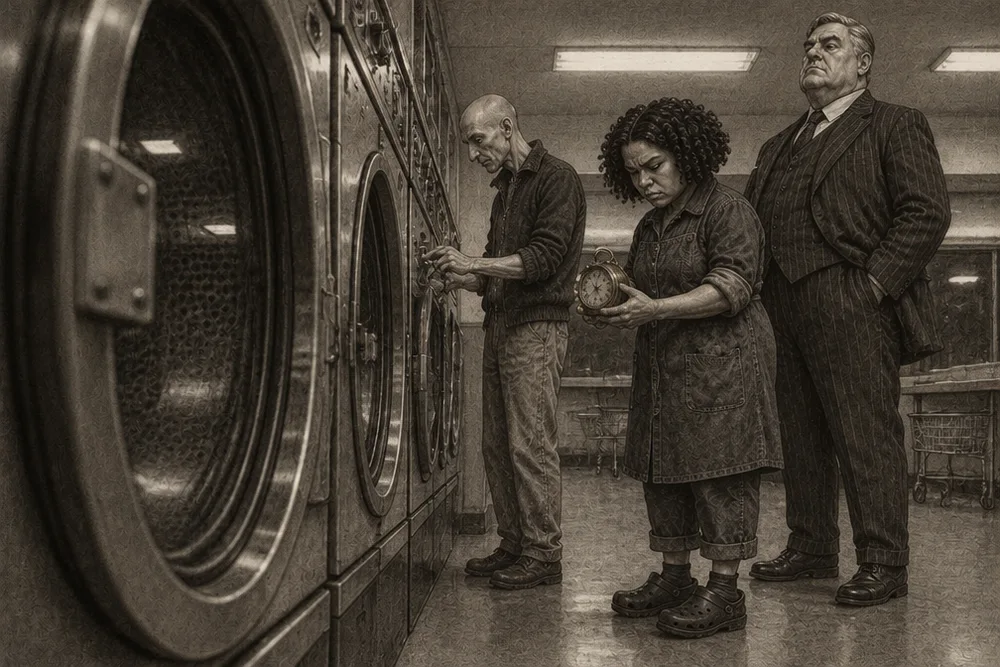
“Eight minutes,” Vela said.
“Nearly.”
“My watch says eight.”
“The overlap takes nine minutes. We came through at the start.”
“And we’re back.”
Ivo looked at the clock in her hands. The brass spring had settled against the movement, its tip pressed into a notch in the case. It was bent, but not broken. “It held.”
“I know. I was there.” She checked the pocket of her smock. The stub was still present, its edge crinkled under her fingers. “This is real.”
“Yes.”
“Real doesn’t mean it means what we think.”
“No.”
“It means we have to find out.”
He nodded. The shape at the far end of the room was gone. Vela turned toward the office window, expecting the strip of light that usually showed under Rusk’s door. The office was dark. Through the glass she could see the square outline of his desk, the metal tenant ledger, the neat stack of eviction notices.