The Laundromat Where Clocks Go Missing
Page 59 of 213
Chapters
The outline of the rear wall wavered. The shelves and detergent sign remained, but behind them another room occupied the same space: taller, rougher, lit by a single hanging lamp. The dryer row was gone. In its place, a pay wicket stood in a wall of dark boards. A brass grille crossed its little square opening; the metal was worn smooth where hands had passed coins and tokens through it. The rest of the mill was a depth of shadow, with a hint of beams and machinery above.
The transformation did not arrive as a flash. It settled in, layer by layer, like dust. Vela saw the laundromat’s drain grate at her feet and, through it, the shadow of a steam pipe beneath old brick. The air smelled of hot iron and damp wool. The silence was full of a distant, rhythmic clatter.
“That’s Selwick,” she whispered.
“The other Selwick.”
The clock ticked once. Its hands shifted together by a hair, though the time stayed 2:17.
Vela looked down at the dryer door. It was no longer a door; it was a broad, dark opening into the old mill’s pay room. Her stomach tightened. Somewhere beyond the walls, a loom started and stopped. The sound rolled through the floor, heavy as a train.
“Go,” Ivo said. “Nine minutes.”
Ivo stepped through first, then turned and held out a hand. Vela did not take it. She kept one arm curved around the clock and crossed on her own, moving between the dryer’s circular opening and the brickwork that had appeared behind it.
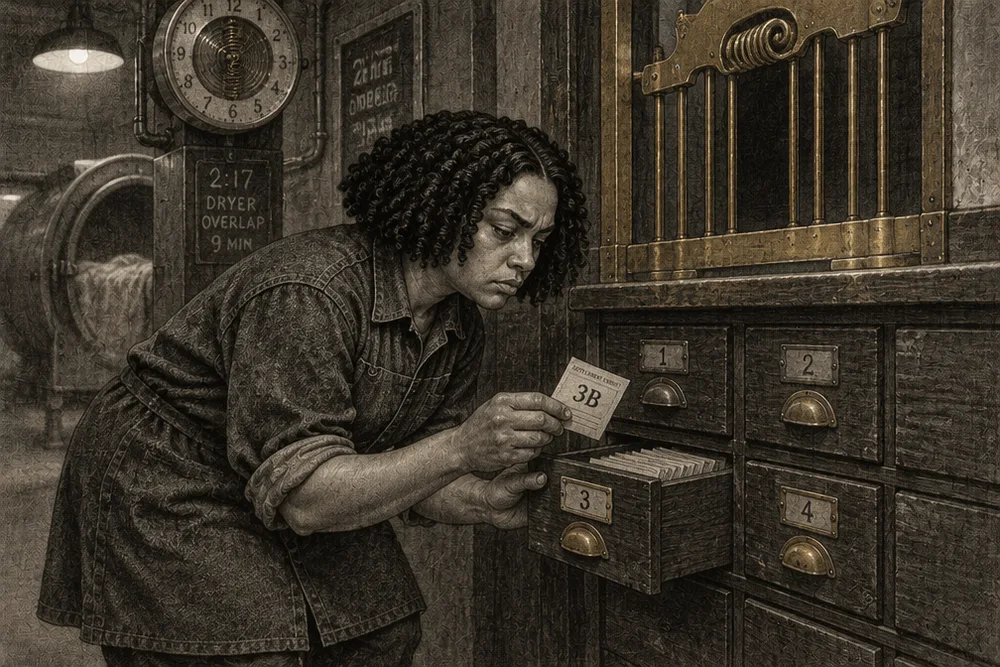
The air on the other side was warmer and thick with lint. Her rubber clogs met uneven boards. The laundromat’s fluorescent hum continued behind her, but muffled, as though it came through a closed door. Ivo pulled the dryer’s metal lid down without letting it latch. Its round window now framed the laundromat in a wavering oval: the counter, the detergent sign, a strip of gray floor.
“Don’t go far,” he said.
“You said the wicket.”
“It’s right there.”
The pay window stood six paces away. Its brass grille had been painted over once, but the old polish shone through in a dozen worn bars. A narrow ledge beneath it held a wooden tray, divided into slots. Each slot had a number burned into the front. The numbered drawer Vela needed was the fourth, marked with a shallow punch that resembled the tally scratch on the clock.
“That’s the drawer?”
“That’s where the index points.”
“You know it from this clock?”