The Laundromat Where Clocks Go Missing
Page 50 of 213
Chapters
Vela studied the cramped list. A name she knew from upstairs appeared beside a sum of forty-two. Another was a woman who had not come down from her flat in months. “Did they all consent?”
“They signed beside their amounts.”
“And the money?”
“Still sealed.”
“Where?”
“Not here.”
She folded the notice carefully along its old creases. “You’re asking me to believe an escrow I can’t see, a notice Rusk might deny, and a history the public record says doesn’t exist.”
“No. I’m asking you to check what I say.”
“How?”
“The clock numbers and the payroll diagram.”
“You said the numbers correspond. That’s not proof the drawers are there.”
“Then we find one.”
Vela glanced at the wall clock above the detergent shelves. It was only 12:31. “You want to go into the mill?”
“I want to show you the pay wicket.”
“It’s fenced. The building’s condemned.”
“The route isn’t through the gate.”
“You mean the dryer.”
He did not reply.
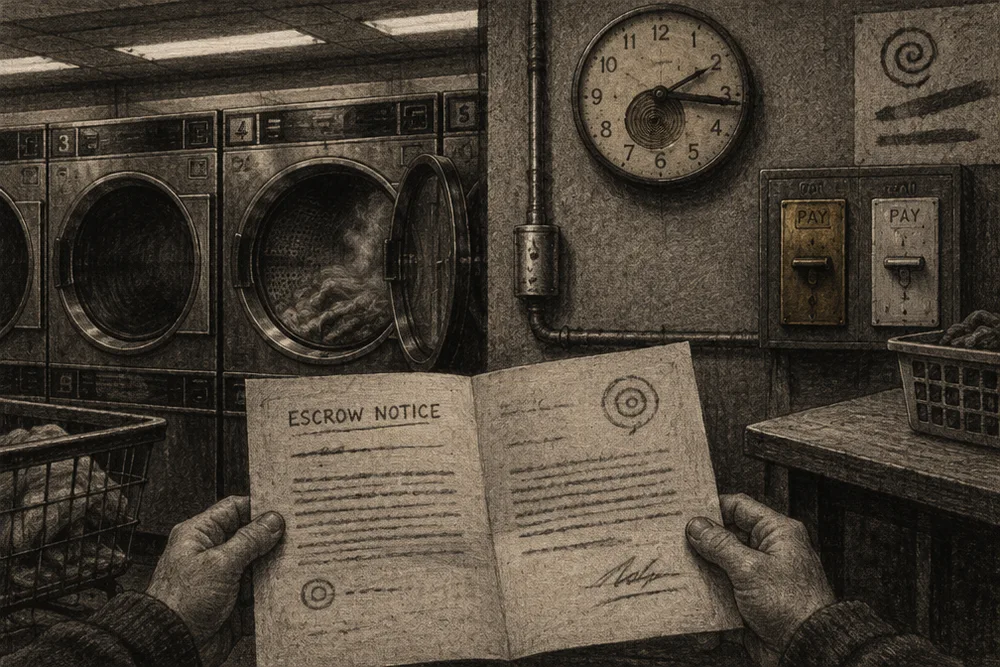
The answer was in the quiet. Vela thought of the city printout, the single official history typed without hesitation. She thought of the clocks appearing in successive dryers, their balance springs missing, each one waiting with its numbered back. If Ivo could take her across, she might find a physical drawer that corresponded to a municipal diagram. If the route was real, it would establish that the second account existed somewhere beyond Rusk’s private ledger. If it was a trick, she would be standing in a condemned mill with a man she had every reason to distrust.
“I want the envelopes accounted for first,” she said.
“I’ll show you the inventory.”
“Not tell me. Show me.”
“All right.”
“And I won’t sign a statement calling you innocent until I can prove it.”
“I haven’t asked you to.”
Vela kept the notice. “I’ll decide after I see the count.”
Ivo led her upstairs to the narrow room behind the boiler controls, where the tenants kept spare mop heads and broken chair legs. He unlocked a metal cabinet with a key on a thread around his neck. Inside sat a ledger, a roll of paper seals, and a stack of envelopes bound in twine. He did not touch them while Vela examined the covers. Each envelope bore a tenant’s name and an amount, written in Ivo’s square hand. The seals were intact.
“These are the deposits?”
“What I moved.”
“And the others who agreed?”
“Their money was held in the same way, but in separate envelopes.”
“How many?”
“Eleven.”
“The notice lists eleven.”
“Yes.”