The Laundromat Where Clocks Go Missing
Page 175 of 213
Chapters
Mara arrived before the list was finished. She had changed into her pleated skirt and a clean blouse beneath the quilted vest. Her white braid was pinned close to her head. She carried no papers. Vela wondered if that meant she had decided to speak only after seeing the exhibit, or if she had come to tell them she would not.
Kit showed her the certified filing, opened to Rusk’s signature. Mara examined it without touching the page. Then he showed her the copy of the escrow inventory. She read the totals twice and asked whether the tenants had confirmed each amount themselves. Vela told her about the witnesses and the sealed submission.
“Then I’ll be there,” Mara said. “I’ll say what I know. I won’t pretend my signatures were forced. I signed the sheets. I told myself I was keeping people employed, and I was wrong. But the brass was not a coupon somebody handed out for a celebration. It was the mill’s payment, and it bought rent credit by its face value.”
She paused. “The excess had to come back as change. The rent agent could not keep it.”
Vela’s shoulders loosened. That was the essential sentence, but it did not make the testimony safe. “You’ll say that under oath?”
“I’ll say it where the record can hold it.” Mara glanced at the sealed folder. “And you’ll keep the strip intact?”
“Yes.”
Kit finished the list and passed it around for everyone to check. Ivo signed beside the inventory. Mrs. Aven confirmed her receipt. Vela wrote her own name beside the strip and noted its condition: folded, brittle, signature legible. She did not like describing it as an object. It had become a narrow bridge between the account in the old mill and the names on Rusk’s present-day arrears notices.
The room’s window faced the canal. Across the water, Selwick Mill’s fenced yard was barely visible beyond a row of roofs. The pay wicket could not be seen from here. In one version of the closure, it had been painted over; in the other, its brass face remained worn by workers’ hands. The hearing would not reopen the route. It would decide whether the papers and the people who had kept them could make the present record answer for what it contained.
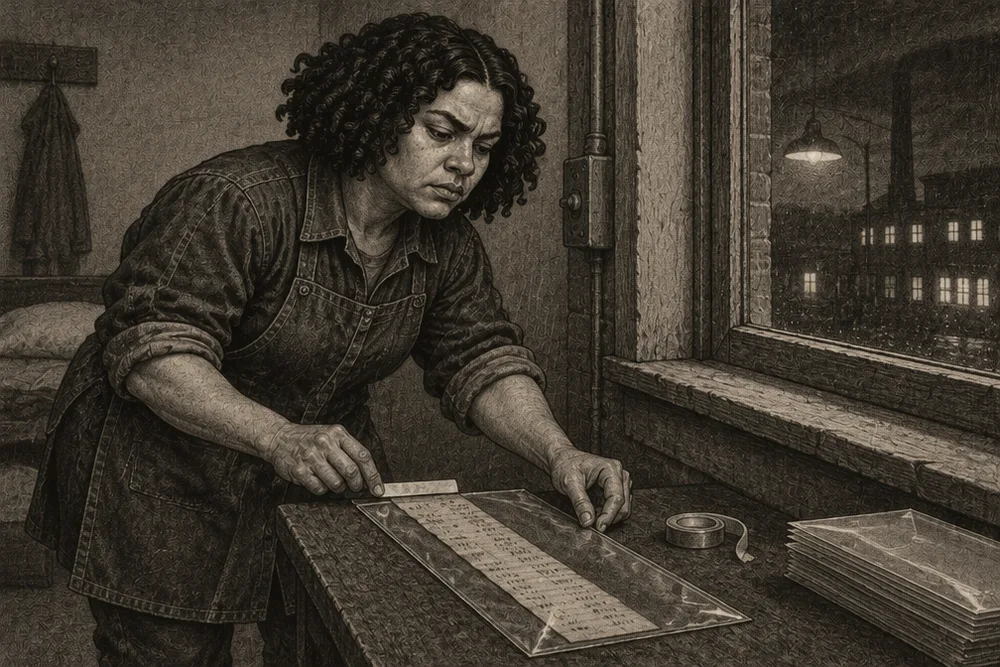
As the meeting broke up, Vela stayed behind to wrap the receipt strip in another layer of waxed paper. She made no attempt to flatten the folds. The paper whispered softly when she eased it into place. The signature remained visible through the thin sheet, and the little columns of figures ran toward the torn edge. She placed it in a rigid document sleeve and wrote her name and the time across the closure flap.