The Laundromat Where Clocks Go Missing
Page 124 of 213
Chapters
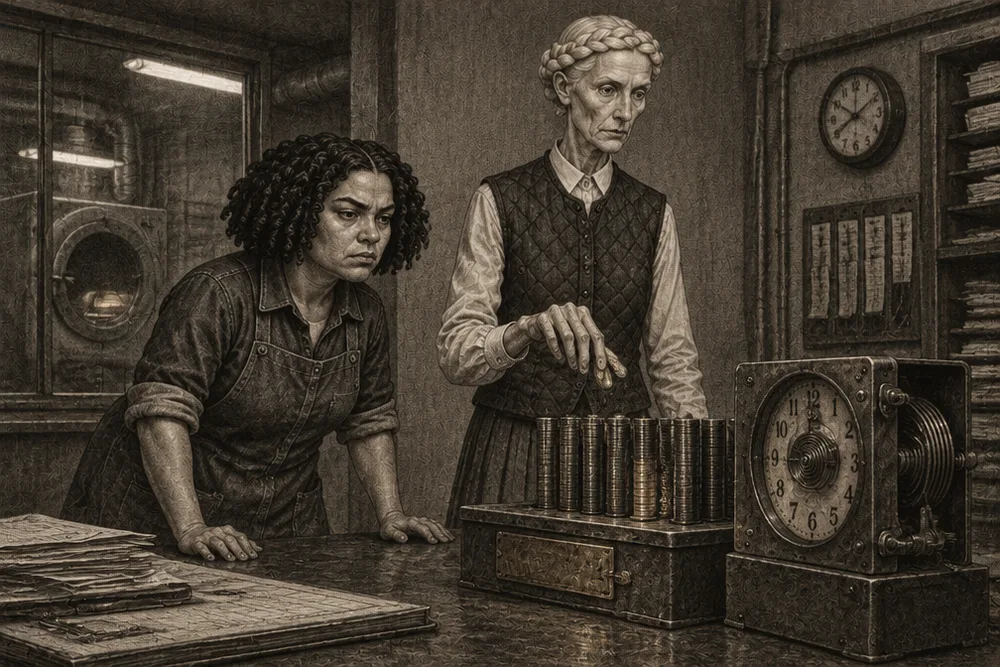
“So tenants could pay rent with them.”
“Up to the amount of rent. One credit for one unit of rent. If a household owed twelve, and presented credits worth fifteen, the rent office could retain twelve. It could not retain the other three.” She traced a route in the air above the figures. “The extra three were change. They had to be returned in brass.”
Vela glanced down at the column. Some entries carried a small hooked mark; others had a pair of short strokes beside the totals. She had thought they were clerical flourishes. “Returned to the worker?”
“To the household that paid them. It mattered. People had earned those credits. They could use the change toward the purchase option or keep it against a later month. The office was not permitted to turn an excess into a gift.”
“But the schedule says retained.”
Mara’s mouth tightened. “That was a tally. A temporary tally.”
“It has been kept for eighteen years.”
“I know how long it’s been.”
The answer came with enough force to stop Vela’s next question. Mara looked away, toward the windows where dryer exhaust had fogged a narrow stripe across the glass. Beyond it, the mill block’s walls rose in soot-dark planes. The laundromat had been built into the old washhouse, and its floor still sloped toward a drain that had once carried steam and water from the factory. “The accounting was supposed to be settled when the option was exercised,” Mara said. “There was no clean closing. The works shut. The office closed. Some records went to the receiver. Some stayed in the pay cage.”
“And the people who had been overcharged?”
“They were told their balances would be reconciled.”
“By whom?”
“The rent agent.”
Vela held still. She saw Dane Rusk’s polished boots on the office stairs, the chalk stripe of his coat, his chin raised as he called a tenant’s credit claim imaginary. “His predecessor?”
“The agent at the time.” Mara’s eyes returned to her. “Don’t put a name there until you can prove it.”
Vela let the caution settle. It was not a refusal, exactly. It was a boundary drawn by someone who had watched the wrong detail ruin the whole account. “What did the change fund?” she asked. “If it was supposed to go back to the households, why was it kept in the first place?”
“It wasn’t meant to be kept. It was meant to be accounted for.” Mara’s fingers moved, counting without touching the page. “A worker might pay a month’s rent with credits, have a little left, and leave it against the purchase option. The office had to show the amount, return the excess, and enter the retained balance where the household could claim it. The change column was there so no one could quietly turn an overpayment into rent.”