The Laundromat Where Clocks Go Missing
Page 113 of 213
Chapters
They carried the demand upstairs to the rent office door. Kit knocked twice. After a pause, the lock turned, and Rusk opened the door as far as its chain allowed. His chalk-stripe coat was immaculate; the polished toe of one boot showed behind him. He looked first at the papers, then at Vela.
“You’re no longer employed here,” he said. “You have no authority to organize access.”
“We’re tenants,” Vela replied. “The washhouse is named in our leases. We’re requesting an attended laundry slot. We’ll be there tomorrow at eight. We’ll bring the tenants whose property you seized.”
“I seized no property. I removed abandoned items from a hazardous area.”
“Then returning it to its owners should be simple.”
His heavy lower lip pushed forward. “The back row is out of service. There will be no access until the conduit work is complete.”
Kit raised her pencil. “For the record, are you refusing the request?”
“I am telling you the room is unsafe.”
“That’s not the same answer.”
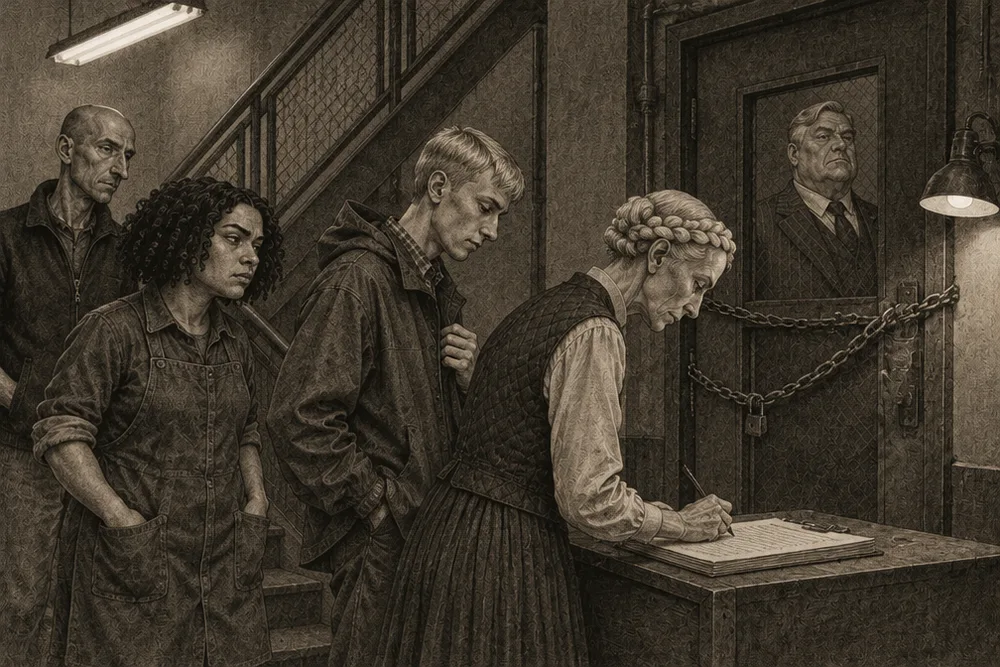
Rusk’s eyes settled on Kit. “You work for the municipality. You should be careful about taking sides in a private dispute.”
“I’m careful about dates and signatures,” Kit said. “That’s why I’m writing this down.”
The door shut. The chain rattled, then the lock clicked. Kit wrote the time and Rusk’s words on the demand copy. She asked two tenants in the corridor to sign beneath her note. One was a widower from the third floor who had a laundry basket on his hip; the other, a girl in a school sweater, said her mother’s clock was among the things Rusk had taken. Their names made the refusal less private.
By morning, word had gone through the block. People came down the stairwell carrying leases, laundry baskets, and old receipts. Some had never spoken to Vela except to ask which dryer ate buttons. Now they stood in the narrow hall to add their names to the request. Ivo arrived last, quiet as always, his long forearms tucked against his sides. He carried no basket. In his other hand was a small cloth bundle.
“What’s that?” Vela asked.
“A spring.” He kept his voice low. “A spare. Not the clock.”
“The clock is still upstairs.”
“Then we get it with the rest of their things.” He looked at the crowd. “Together.”
Vela felt the folded demand in her pocket, the pressure of every signature through the paper. Rusk had built his certainty on separate tenants, separate receipts, separate versions of what they owed. Their small gathering in the stairwell made a different kind of record. She lifted the request. “Tomorrow at eight,” she said. “We come as leaseholders, not as trespassers.”