The Last Room for Fog
Page 139 of 220
Chapters
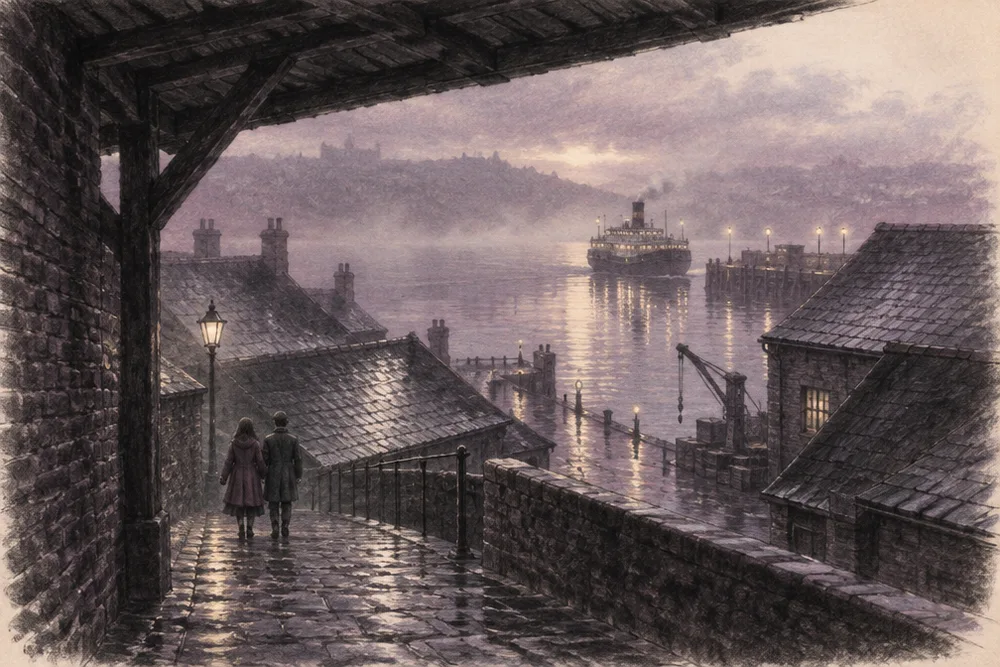
Bess walked on Jory’s left. Her stride was brisk, but she did not hurry him. He kept his hands in his vest pockets, careful not to reach for the budget he no longer carried. It was a small, nearly ridiculous discipline. He had been accustomed to finding a task whenever the silence became difficult.
“You know,” Bess said, “I used to think you were never afraid of anything.”
He turned his head. “That’s a surprising assessment.”
“You always seemed to know what to do. Tune the piano. Teach a step. Find somebody a coat. Make a room feel as if it had always been waiting for them.”
“I was afraid of quite a lot.”
“You hid it well.”
“I hid it by doing things.” He watched the landing boards pass beneath their feet. “It meant people didn’t have to wonder whether I could help. It also meant I didn’t have to ask what they wanted from me.”
She was quiet for several steps. “I thought you wanted me to stay.”
“I did.” He did not add that he had wanted it so badly he had made her silence into a judgment. “I also wanted you to tell me why you were leaving. I thought if you trusted me, you’d say it.”
“I should have.”
“Yes.” He looked at her. The word had come out without punishment in it, but it was true. “And I could have asked instead of waiting for you to make it easy.”
She lowered her eyes to the harbor. A ferry was approaching, its shape growing through the thinning fog. “I was scared that if I told you, you’d offer to solve it. I was scared you’d ask me to stay when I couldn’t. And I was ashamed that I’d been counting pennies while you thought I had choices.”
“I wouldn’t have wanted you to stay out of obligation.”
“I know that now.” Her voice held no triumph. “I didn’t know it then.”
The ferry crossed behind them, windows lit in a row. Neither turned toward the timetable. For once, there was nowhere they had to be on its account.
At the end of the landing they took the path that climbed above the quay. It was not the quickest way to either of their rooms, but it offered a view between the warehouse roofs: the ferry sliding toward its berth, the slip lights reflected in the harbor, the wet slate of the lower quay. Bess’s sleeve brushed his. He let the contact remain ordinary.