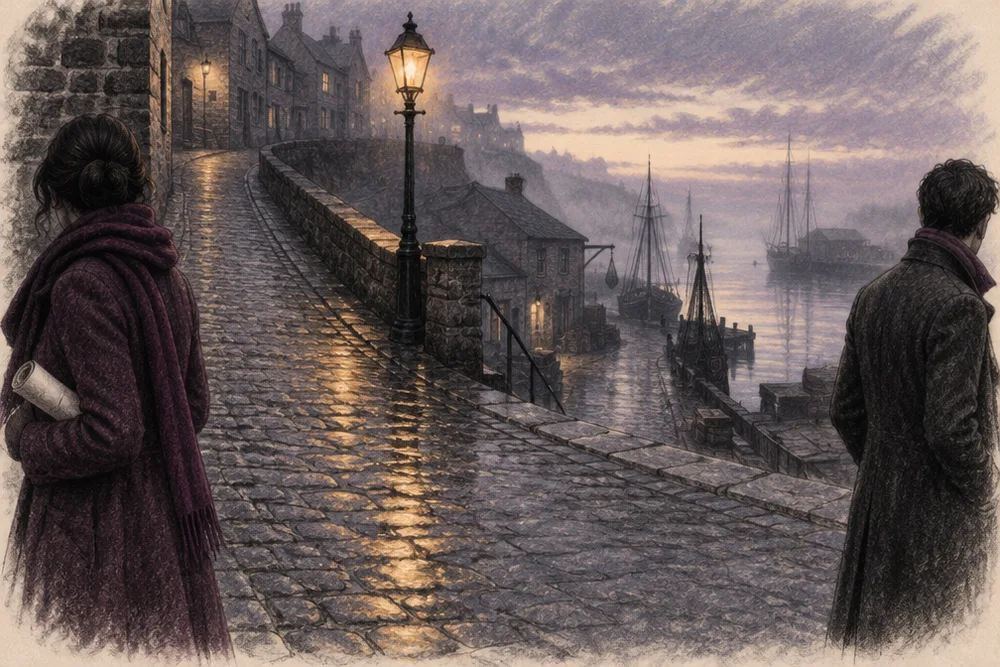
The Last Room for Fog
Page 136 of 220
Chapters
He thought of the donation tin, his own coins moved from the tuning case when no one was watching. He had thought the money would help people stay. It had also meant they could not see the real price of the room, could not decide whether it was worth meeting. “Kitto said they’d rather learn the actual cost.”
“They’re right.”
“You’re not going to tell me it’ll be fine?”
“I won’t tell you a thing I don’t know.” She glanced at him. “It might be fine. It might not. We’ll find out.”
The pavement climbed away from the slip. Beyond the chandlery, the windows of Rill’s Alterations shone warm against the wet evening. The cutting table would be clear by now, waiting to turn into a finance desk. Jory could picture Una’s chalk-marked thimble beside the ledger, her narrow hands crossing out any unpaid labor without hesitation.
“You want to go in?” Bess asked.
“Not tonight. I said I’d price the equipment first.”
“You don’t have to prove you can deliver it before you take the route.”
He heard the edge of the old pattern in the sentence, and the kindness of her seeing it without making a performance of seeing it. “I’m not trying to prove I deserve it.”
“Good.”
She stopped at the corner where the way to her lodging turned uphill and his own rooms lay beyond the chandlery. The budget made a soft, dry sound beneath her arm. He wanted to touch her shoulder. He wanted, also, not to make every quiet moment a test of whether she would let him.
“I’ll send the costs before Friday,” he said.
“Bring them. Don’t send them with an apology attached.”
He smiled. “I can manage that.”
“We’ll see.” Her mouth softened at last, not quite a smile, but close enough to make him remember the summer when they had both stopped just short of saying what they meant.
Bess shifted the papers and nodded toward the uphill road. “Good night, Jory.”
“Good night, Bess.”
She walked away without turning to see if he watched. This time, he let her go without pretending that it was the same thing as not wanting her.
The next morning Jory went first to the shop in Vennick. He asked the proprietor for a firm schedule and the names of the instruments on the route, then wrote down the two Saturdays in each month he would be away. He did not call it a conflict or a complication. It was work, and it had a shape.