The Last Room for Fog
Page 106 of 220
Chapters
They tried it twice more. On the third pass Kitto took the lead, changing direction halfway through. Jory’s body obeyed before his thoughts did. He landed with one long forearm braced against the post, his hip automatically finding the nearest support.
Kitto grinned. “You can follow when you stop planning what I’m supposed to do.”
“That’s a useful lesson.”
“It’s the one you’re paying me for.”
Jory glanced at them. “I’m not paying you.”
“Exactly.” Kitto’s grin went away. “You keep teaching everyone like that settles it.”
The remark found its place in Jory’s chest and stayed there. He looked beyond Kitto to the tide-wet slip, where a deckhand walked a coil of line from one bollard to another. The landing was full of people between tasks, not exactly idle and not free: a woman with a basket of laundry, two crew members trading a thermos, a boy counting the bolts on the rail while his father read the sailing board.
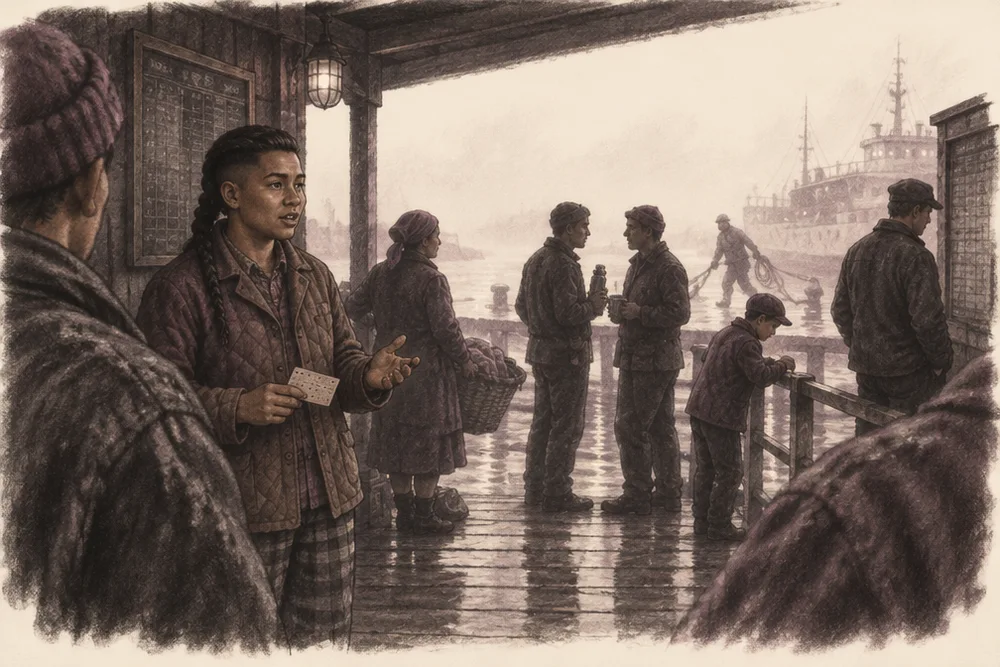
“What would settle it?” Jory asked.
“You asking what we need before you tell us what you can provide.” Kitto tucked the punch card deeper into their pocket. “I said I wanted to learn. I didn’t say I wanted Tuesday to belong to you.”
Jory felt the old defense rise up: Tuesday was the only night he could reliably open; the hall cost money; he had made it work when nobody else would. Each point was true, and none answered Kitto.
“I thought it was the only night that worked,” he said.
“For you.” Kitto glanced toward the harbor. “I’ve got two shifts. Plenty of us do. Some weeks the only hour we share is the hour before the last boat.”
Jory had heard the timetable discussed as a limit, never as a map. On his own, he had penciled lesson times around his tuning route and the hours the old caretaker had been willing to unlock the engine house. He had counted whoever showed up. A face at one lesson and the same face at another had become two entries on his sheet; he had counted a person twice because the room was crowded and he wanted the numbers to look alive.
He had not counted the split shifts as one crew, either. There were people he never saw because he taught when he could get there, and people who came only when a ferry ran late. He had called the regulars the community because regulars were easy to recognize.