The Last Crossing Is Free
Page 34 of 226
Chapters
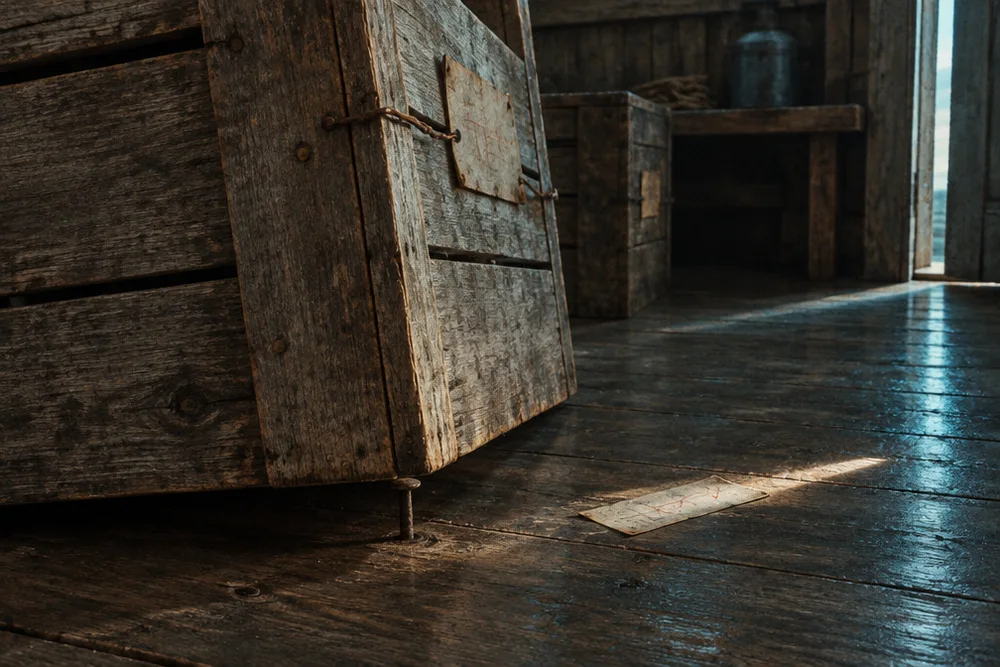
The ferry lifted. Nothing on the bench moved, but the crate she’d brought to the light rocked once on a proud nail in the floor. She caught its corner with her boot. There was no reason to leave it there just because she could read it better there. She took it by the lower slat and slid it back toward the wall, stopping when the wire on its card came close to the next crate. If the hull rolled farther, the wire would score the wood or catch and tear its own label off.
She took the coil the deckhand had left and worked a turn of it low across the load, below the cards. Its stiff outer loops wanted to keep the shape they’d had over his shoulder. She shook out a shorter length than she’d intended, fed it through the bench support and took up the slack. The bench shifted. She set her heel against its foot and tried again, pulling across the floor this time instead of up. The bench stayed put. The crates could still be freed from the passage without reaching behind them.
There was more line than she needed. She wound it back into a flat coil and tucked it out of the way. She had meant the first thing she tied down aboard Little Wake to be a load she could put a price on. At least on this one she could say what the line was for.
She stood in the passage and stretched one arm across the cleared strip, judging the width with her hand. Enough for a sack turned on its seam; not enough for the trial load to sit without making a wall between the cabin door and the controls. She could carry a part load in the space. Nobody at the other end had booked a part load.
The tide note lay where she’d set it down. On one side were the old soundings and on the other her red diagram and the list. She set it on the bench and drew a short bar where the line now passed across the crates. It helped to separate the things she’d decided from the things she had only drawn. The flour stacks were still squares with nothing in them.
At the foot of the list she left space for a name. She had wanted one person ashore who could say where the boxes had come from and another who was supposed to get them. The barrow would have let her go without either. It would also have made her the person everybody had to find. She was that already, in a way, but at least anyone who came to the ferry could look at a label and tell her if she’d read it wrong.