The Hours We Kept Quiet
Page 50 of 298
Chapters
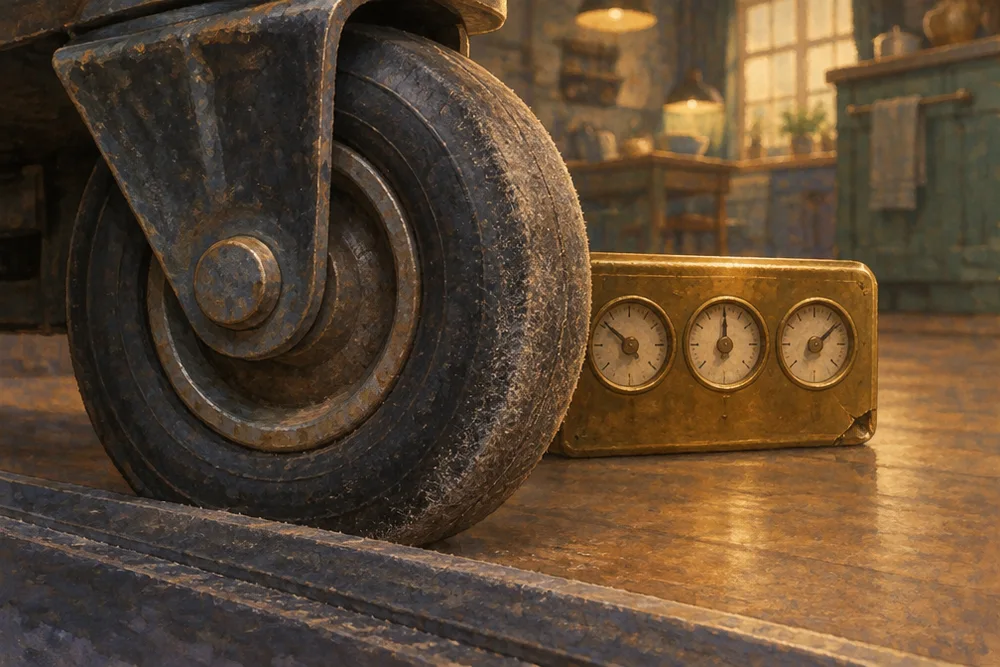
Fara watched the dials on the brass meter. They moved in their separate little circles, registering the opening, the stop, the passage. The minute held. Eska crouched to retrieve the caster, then looked at Fara instead.
“It feels ordinary from here,” she said.
“It isn’t ordinary.”
“No. But it feels like a floor.” Eska turned the wheel with one finger. A gray smear marked her skin. “You want to take everyone out?”
“I want to know whether I can.” Fara had brought a list of names, not an answer. “If the district’s going to be pulled back, there may be a way to move people first.”
Eska studied her. “And after?”
Fara didn’t reply before the pause began to close. She watched the caster cross back into the cage. The wheel spun once against the metal floor and came to rest, carrying a veil of fine kitchen dust in the grooves of its worn rubber. The seam vanished. The lift door shut with its familiar, ordinary clank.
Fara picked up the caster. Dust sprinkled onto her palm, pale as flour. On the other side of the cage, Bram leaned forward, waiting. “It came back,” she said.
“I can see that.” His eyes stayed on the wheel. “What came with it?”
The next day, Fara took the caster to Nell’s kitchen. The rooms beyond the threshold were still there, their warm light held between the city’s counted hours. Nell stood by the worktable in an ash linen shirt, shoulders rounded, brass key on a cotton loop at her waist. She read the dust in the wheel’s grooves without touching it.
“The opening returns what crosses,” Fara said. “At least, it returned this.”
“People aren’t wheels,” Nell replied. Her chin stayed down as she spoke. “A doctor wrote something down about that. I kept the note.”
She disappeared through a narrow doorway and came back with a folded paper, creased soft from being opened. The ink had faded unevenly. Nell laid it on the table beside the caster and flattened it with one broad forearm.
The note was from a physician whose name Fara didn’t recognize. It recorded residents who had crossed during an extended opening: dizziness, trembling, confusion, and a sudden snap back when the interval ended. Not everyone had reacted alike. Some recovered quickly. Some were unable to stand. A later line, written in a different hand, warned against treating a crossing as a safe evacuation route.
Fara read it again, slower. “You knew?”