The Hours We Kept Quiet
Chapter 19 · The Dial That Would Not Settle
Page 226 of 298
Chapters
The first shared stop was due at dusk, and the protected circuit held. Fara stood at the Kettle Lift’s control rail while the stair lamps burned steadily down Vane Court, each one a small amber bead in the basalt dark. The reserve feed hummed through its new line. No sudden dip. No shiver in the bulbs. On the load board, Iven’s chalk marks stayed level.
“That is the part we know how to do,” Iven said. She had planted her feet wide beside the board, rust cape buttoned against the shaft’s cold draft. “The circuit keeps its promise.”
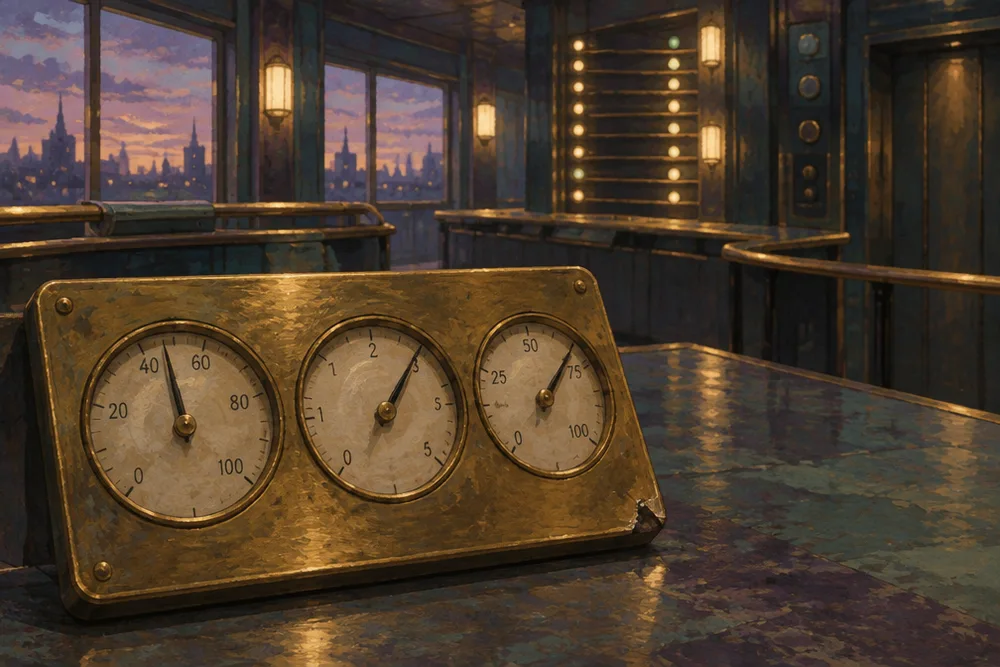
Fara rested one hand on the brass meter clipped to her belt. Its three round dials showed separate readings for the lift’s stops. A nick in the lower right corner caught the light. “And the part we don’t?”
“The kitchen dial.”
At the far end of the dispatch chamber, the dial was mounted in a square of old white tile. Its needle trembled between two marks, swung left, shuddered, then swung right. The mechanism clicked with each movement. It did not settle at the pause or at the city’s ordinary hour, but seemed to be listening for a signal it could not hear.
A line of residents waited beyond the hearing booths. Some had come from the Unentered; others from the lower landings whose lamps were now on the protected circuit. Nell stood near the front, chin lowered, one broad forearm across her plum sash. Eska was beside her, holding the dented tea strainer in both hands. No tea in it now, only a little fleck of leaf caught in the mesh.
“It will settle when the minute comes,” a freight dispatcher called from the back. “That’s what the trial was built for.”
Fara watched the needle skip past the mark again. “The minute is not the problem,” she said. “It’s what the clocks think comes before it.”
The city clock above Needle Hall counted down with a slow, weighty clank. Its descending clock weight passed behind a grille, lower each second, while the public load board glimmered with chalk-white figures. The hearing booths were full; remote tenants waited at cable-office receivers, their voices just audible beneath the machinery.
Fara stepped to the load board. Iven had written the new allocation in clean columns: peak-use fees, paid waiting time, protected access circuit, daily pause assigned to the district. The vote had made the figures real. Each number meant someone had agreed to pay, or wait, or surrender a preferred hour. For the first time, the pause had a place on the schedule that was not a blank.
The kitchen dial kept moving.