The Hours We Kept Quiet
Page 31 of 298
Chapters
When his shift ended, he followed the cables downhill, away from the public routes. Drail’s terraces curled around the dry brine shaft, stairways laid one above another in a steep, crowded spiral. The upper shops had polished brass lamps that stayed bright through the pause. Below, the tenants shared dim stair globes and learned to judge the steps by touch.
Jory knew the cable runs as a clerk knew them: by the vibration underfoot, by the smell of damp insulation, by the places where the conduit had been patched with a different color of metal. He took a narrow service stair past the laundry wall. Warm dampness breathed out through the slats, carrying soap and old steam.
At the foot of the stair, one cable dipped beneath a cracked arch and vanished behind a panel that did not match the stone around it. Jory knelt and listened. Beyond the panel came a faint rhythm: a hand striking a tabletop, pause, two quicker taps. Then a child’s voice counted, “Again.”
He stood up. A line of chalk had been drawn across the arch at ankle height. Someone had passed through recently enough to leave the chalk clean against the dust.
The panel gave when he pressed the lower hinge. It opened onto a passage that seemed too warm to belong to the stone behind him. Jory stopped at the threshold. Beyond it, light lay in broad, uneven patches across a courtyard floor. A shallow roofless court opened above, though no shaft of Drail’s usual lantern glow reached it.
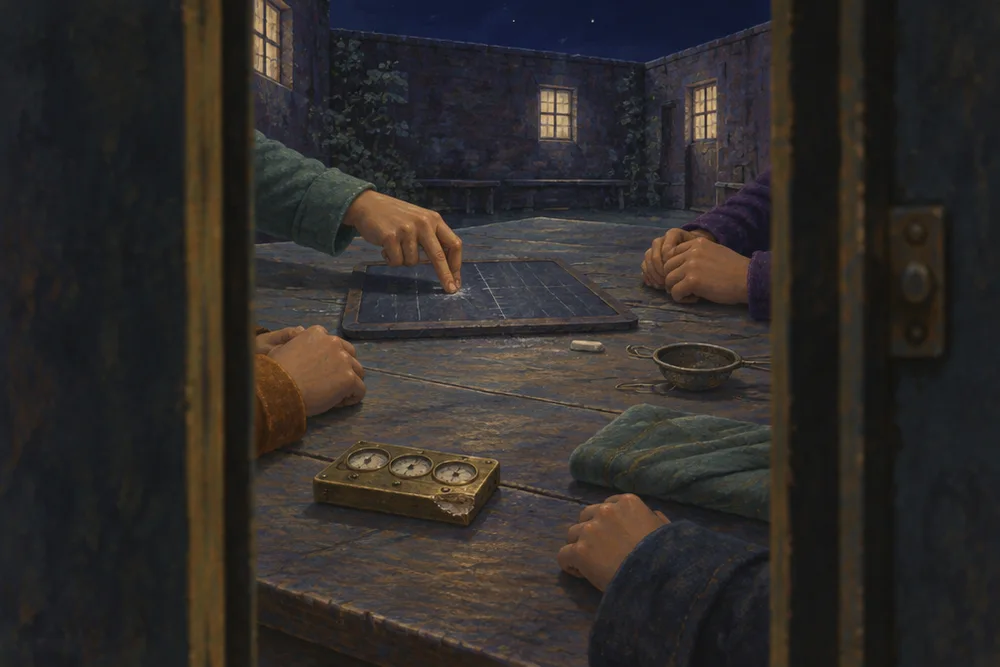
The place had the look of a school between lessons. Benches ran along one wall. A row of slate boards rested on a shelf, their surfaces full of sums and half-erased names. At the far end stood a low door with a cloth hung over its top half. Children crossed the court carrying folded paper and wooden counters.
Jory remained in the shadow of the panel. He could have backed out then. Instead, someone in the court hummed his note.
A boy stood beside a slate board, head tipped as if he were trying to catch the pitch. A girl tapped the tabletop in the same uneven rhythm Jory had heard through the cable. When the boy’s hum wavered, the girl lifted a hand.
“Wait,” she said. “He’s breathing too fast.”
Jory froze. The boy breathed in, then let the air out slowly. The hum steadied. The girl tapped once, twice, twice more. The children counted the interval, not by a clock but by the rise and fall of the boy’s chest.