The Hours We Kept Quiet
Page 159 of 298
Chapters
“If the allocation order passes, the district’s floor isn’t renewed yearly,” Iven said. “The supply can be audited, adjusted through the same public process as any other circuit. But it can’t be cut below the agreed level by a private contract or a dispatch decision.”
The merchants’ spokesman stood. His chair gave a small metallic squeak. “You’re asking us to underwrite an arrangement with no renewal, no guarantee the boundary will hold, and no protection if the city’s own loads rise.”
“I’m asking whether you want to offer power or buy a veto,” Nell said.
A few people laughed, not loudly. The spokesman’s mouth tightened. He folded his gloves together over the silver chain. “We offered a reserve that could be delivered now. I don’t see how a seat on a board keeps a lamp lit tonight.”
“It doesn’t,” Iven said. “The trial does. The allocation has to be built from the loads we can actually move.”
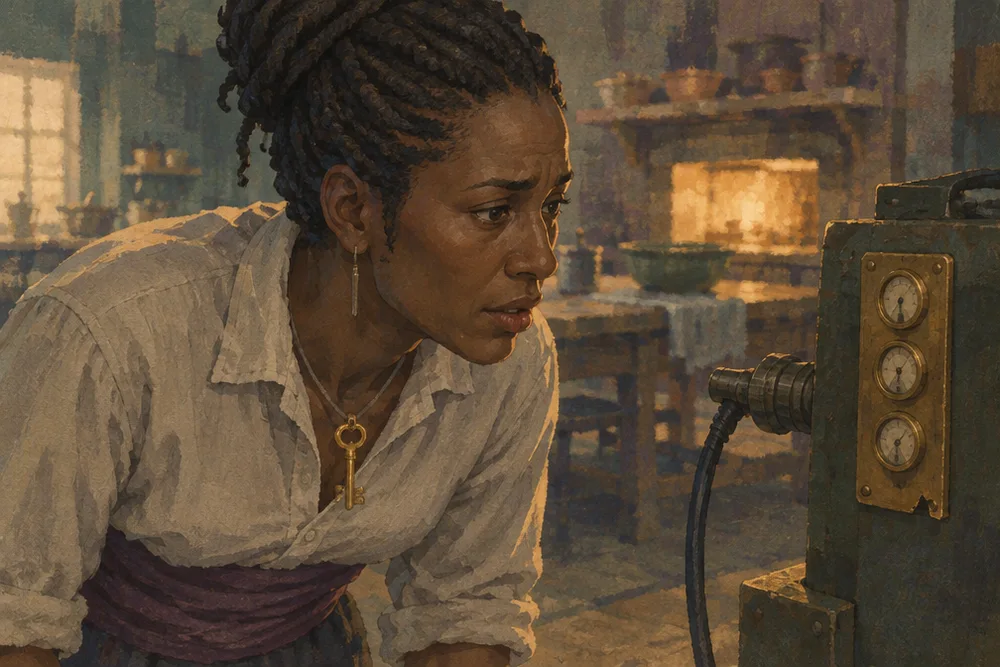
Fara heard the relay hiss. Someone at the kitchen end spoke to Nell in a low voice; Nell answered without turning away from the receiver. The district had already had to decide whether it could live smaller, whether one schoolroom mattered more than the communal oven, whether a room could be given up without giving up the people who had lived in it. Now it was being offered a cushion with a string tied to its renewal.
“We refuse the offer,” Nell said. She did not raise her voice. “We will not sign away the right to remain here each year just to borrow your reserve.”
The spokesman’s reply came quick. “Then you are choosing a riskier course.”
“We know,” Nell said. “We’ve been living in the risk you’re trying to sell back to us.”
The merchants began collecting their papers. No one made a dramatic exit; there were folders to stack, chairs to lift, routes to catch. Their departure was a practical one, which made its consequence all the plainer. The spokesman gave Iven a short nod, neither agreement nor apology, then took his chair toward the door.
“We’re withdrawing the reserve offer,” he said. “The terms are no longer workable.”
The sentence settled over the hall. Fara looked at the yellow trial figures. Without the reserve, the city would have to make the staggered starts work, pay for the transfer windows, and account for the lift and stair lamps as real services rather than convenient exceptions. It would have to face the cost in its own ledgers.