The Freight Lift Below Blue Snow
Chapter 12 · Names Beneath Lanterns
Page 131 of 200
Chapters
By the time Elsa reached the lift house, the high bench had become the only route left to the hatch. Water covered the low passage, and the gallery stair had taken as many stretcher teams as it could. Ada stood at the refuge doorway with a lantern raised and the survey map tucked inside her brick-red jacket. Behind her, evacuees waited in small knots, coats buttoned to their chins, watching the narrow passage climb above the flooded floor.
“Eight at a time,” Ada said. “No bunching at the bend. Keep one hand on the rope. Don’t step over it unless I tell you.” Her voice carried without becoming a shout. She checked each face as she spoke, measuring not distance now, but fear. An older man nodded. A woman held a child’s mittened hand. Nell stood beside the folded stretcher, counting supplies that could not go up the bench.
The lift car waited at the side landing, doors open, its floor filmed with water. It could still carry people to the refuge, but nobody would be sent back through the lower gallery. From there, they would take the high bench to the hatch and the ridge path to the road depot. The climb was slow. The reserve generator had fuel for only so many cycles, and every pause drew heat from the lift house above.
“Your first group is ready,” Elsa told Ada. “I’ll get them across the upper station before the next load comes up.”
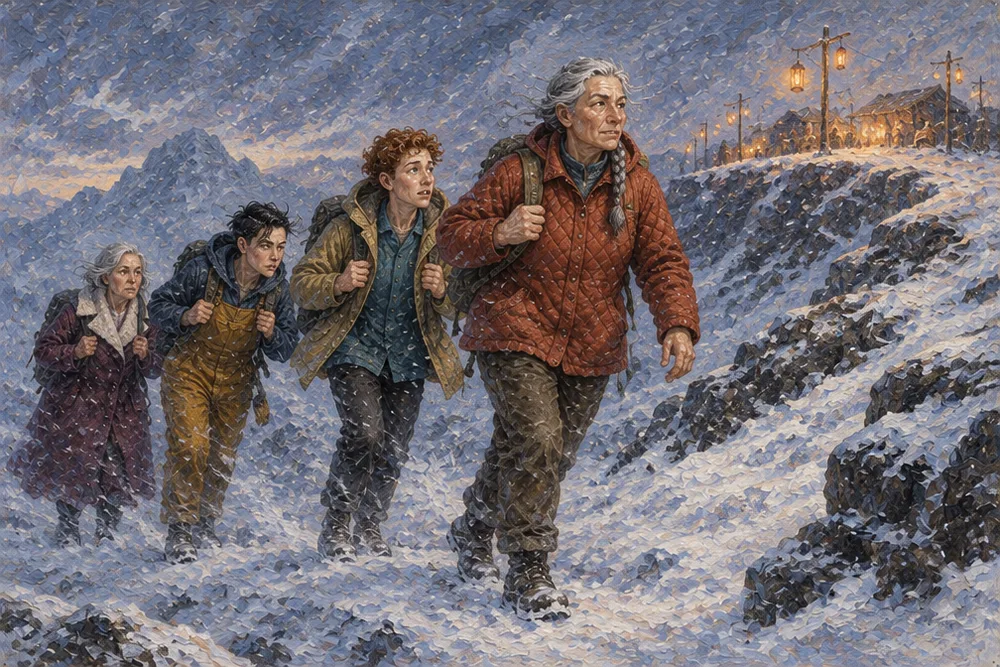
Ada looked from the waiting people to the rope disappearing into the passage. “If the gate stays clear.”
Elsa did not promise. She had learned to test first and say only what the test could support. The upper gate still moved. The hatch was open. For now, those were facts enough.
The car’s chain clanked as the hoist took its weight. Several people turned at the sound. Elsa touched the service bell at her belt, ready to signal a stop if the door failed. When the noise faded, Ada motioned the first eight forward. Boots crossed the raised stone lip one at a time, toward the high bench and the wind beyond it.
The bench had been cut by surveyors before the mine’s last expansion. It climbed above the stretch where the drainage slot emptied, then doubled back along the gallery wall. In places the rock was smooth with old boot polish; in others, it broke into shelves sharp enough to catch a sole. A handline ran between iron staples. Elsa had tested every staple herself. The rope would not stop a fall, but it could keep a tired person from drifting toward the lower edge.