The Freight Lift Below Blue Snow
Page 101 of 200
Chapters
Nell’s mouth tightened. She looked at the patient, then at the row of wool blankets on the bench. “Then we wrap and watch. I’ll stay with them.” She asked a resident to sit near the second stretcher and tell her if the patient began shivering hard or stopped answering. The resident nodded and pulled a chair close.
Mara brought the remaining clinic stock through the passage: medicine, gauze, one small kettle, and the last two bundles of blankets. She placed the kettle on the shelf near the generator. “We can heat water if the load allows it.”
“Only when the car is parked,” Elsa said. “And I’ll check the draw first.”
“Then check it when it’s parked.” Mara looked down at the blanket bundle. Her expression had gone carefully blank again. “The clinic is closed.”
The words traveled through the room. People who had been waiting in the passage turned to look at the dark doorway. Nell closed the clinic door and tested the latch. A label reading CLINIC had been fixed to the glass years ago; the letters were faded where hands had touched it. Now there was no warm light behind them.
Elsa marked the closure time in the log. The generator’s steady rhythm filled the moment after the door shut. The lift had priority. Blankets had replaced the clinic heat. She could hear the difference in the building: no radiator knocks, no warm pipes, only the engine and the movement of people preparing to continue.
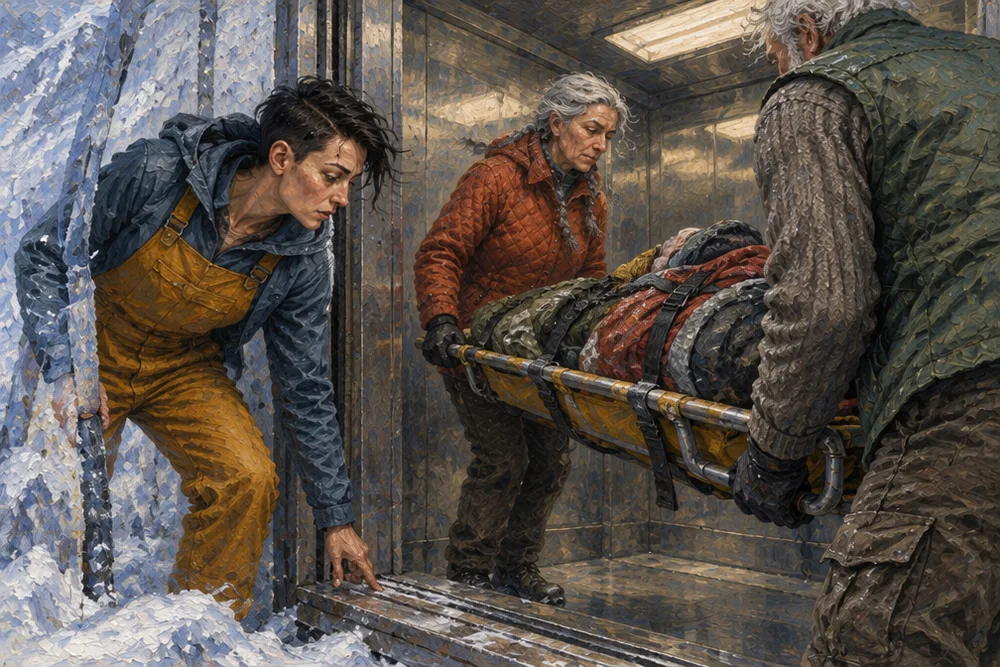
The next transfer carried the two patients and their attendants down together. Elsa watched the stretcher wheels cross the sill, stopping the attendant from lifting the back end too soon. “Keep it level until the car settles,” she said. “There’s room if you angle the frame.”
Nell braced the near side. One resident held the medicine box, and another carried the folded blankets. The patient nearest the doors watched Elsa with alert, tired eyes. “You’re the electrician,” he said.
“That’s right.”
“Then make it keep going.”
Elsa held the door edge while the stretcher cleared the sill. “I’m trying.” She didn’t promise what a machine could not promise. The latch clicked, and she gave the operator the signal.
The car descended. Mara sat on the bench with the tally board across her knees and counted the people remaining in the lift house. She called out the total, then asked everyone to raise a hand when their name was read. A few hands went up slowly, bundled in sleeves and blankets. One resident had gone to help Nell and was not in the room; Mara marked that person separately rather than counting twice.