The Ford That Knew Her Name
Page 5 of 6
The bakehouse door was warm beneath Nella’s palm. Flour reached the baker’s elbows as he listened to the ferryman explain. He opened before sunrise every day; if someone called from the ford, he would hear. Nella showed him the list and pointed west, toward the stone nearest the bakehouse. “Hearth,” she said. “That one is yours to remember.”
The baker repeated it, then all the names in order. Nella drew four small stones on the paper’s back and marked their places between the banks. The ferryman told him to keep the whole sequence inside, not just his own name. One loose board could vanish. A name should not have only one home.
At the thatcher’s cottage, a ladder leaned beneath the eaves. A nest rested in its upper rungs, straw caught around the rim. The thatcher smiled when Nella pointed out Wren. He would teach it to the children who came to climb after the birds had flown. “The order, too,” the ferryman reminded him.
They went next to the reed-weaver, whose bundles stood in a row by the door. Sedge belonged there. She listened with her head tipped close as Nella repeated the list slowly, making sure each word landed. At the last house, across the river, the quilting hosts had a porch lamp facing the ford. Home was theirs to keep. They copied the names twice, once for the kitchen wall and once for a drawer.
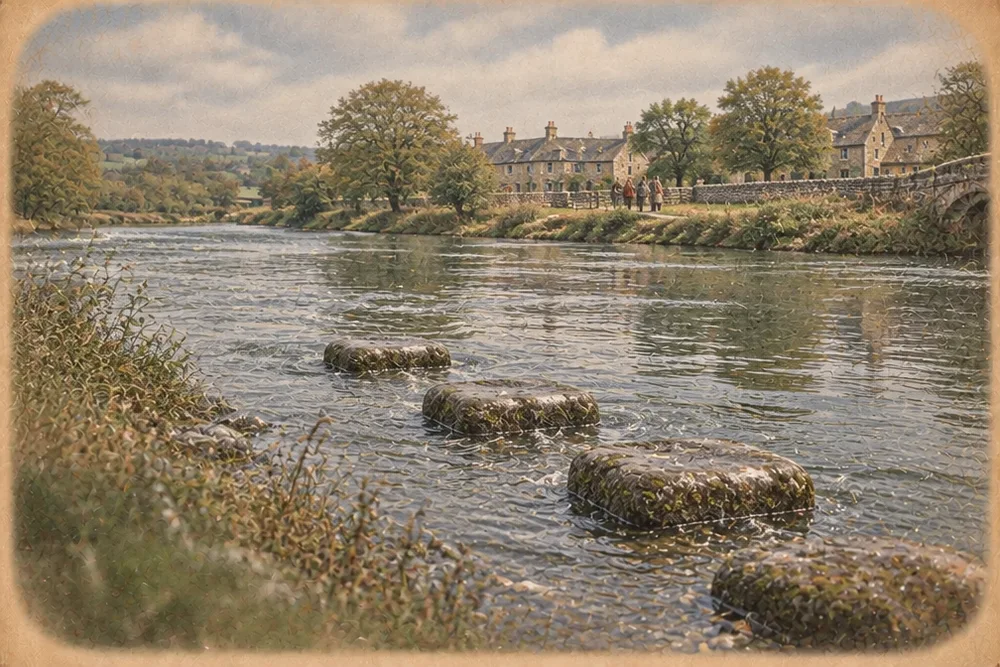
Everywhere, the ferryman knew what to say: who answered at dawn, who needed a knock instead of a call, which doorstep could be reached if the lower path flooded. When Nella glanced at him, he shrugged as if it were no special skill. But doorways opened to him, and people listened.
At the west landing he showed her where high water had once reached, a dark stain on the stile. They marked it with chalk, then made the same mark at the east landing. “Below this,” he said, “a careful person may walk. At or above it, no one tries the stones.”
“And the ferry?” Nella asked. “For high water, heavy loads, and those who need it.” He tapped the brass clasp on his coat. “We’ll keep the posted toll for those passages. Ordinary foot crossing costs nothing.”
By dusk, villagers gathered at the ford. The stranger had come back, though he still could not remember the names. On the banks, the baker called Hearth, the thatcher Wren, the reed-weaver Sedge, and the hosts Home. The words passed from one voice to the next. Across the water, the stones rose dry, one after another. Nella watched, hands tucked into her red cape. No one asked her what came next.