The Dead Get Their Post
Page 73 of 267
Chapters
“There aren’t three of us anymore,” Hester said.
“There were always three kitchens.”
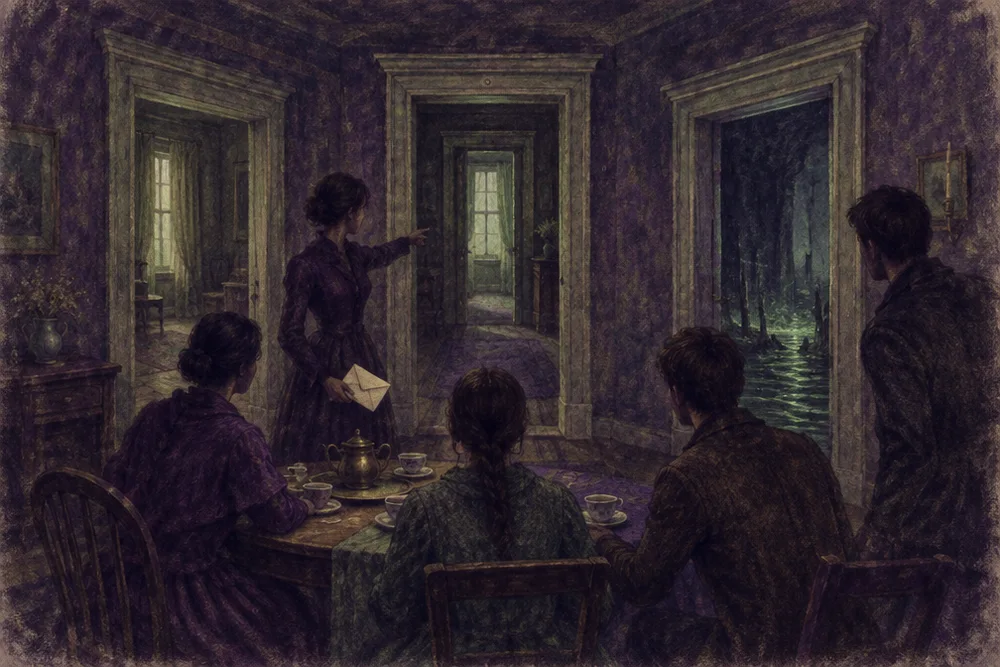
Hester invited Ada to sit in the front room for a little while. Not to stay, she said, and not to claim a room. Just to speak where the others could hear her. The invitation drew two neighbors to the doorway and sent one away. Sella came in from the yard, wiping her hands on her apron. The boy from the small bedroom remained where he was, listening through the open pantry door.
Ada came as far as the front room. Her clothes were ordinary, the sort of dark wool dress that would have passed unnoticed on any Saturday in the village. A green line marked the edge of her mouth. She stood with both hands at her sides, then looked at the three doors that had once opened into her kitchen.
“The stove was here,” she said, pointing to the wall behind the chair. “No, there. The window was there. We sat with our backs to the window when the rain came sideways.”
“That’s the yard wall,” Sella said. “The window is still there, but it looks onto my sink.”
Ada’s face turned toward her. “You wash there?”
“I do.”
“Then I know the place.” She sounded relieved, and for a moment the relief seemed to settle everyone. Hester offered tea. The brothers came in from the yard. A cup was set on the table, though nobody knew which kitchen the table belonged to.
They talked for twenty minutes. Ada remembered a cracked blue bowl, a winter when the chimney smoked, and a child who had once hidden under the table during a storm. The boy in the small room said the hidden child could not have been him; he was born decades later. Hester guessed it was her mother. Ada said no, it was a girl with a red ribbon, and then admitted she might have borrowed the ribbon from another memory.
Merryn took notes without trying to choose which version was true. She wrote the blue bowl next to the house, not beside a door. She drew a line between the three kitchens and added: remembered together; inhabited separately.
When the conversation ended, Ada asked where the letter was. Hester had taken it from the sill and placed it on the table.
“It belongs to you,” Hester said. “I don’t want it inside my room.”
Ada picked it up. The envelope did not pull her from the chair or send her to the passage. She held it carefully, thumb beside the old RETURN mark.