The Dead Get Their Post
Chapter 1 · The Rack With a Keel
Page 1 of 267
Chapters
On Thursday morning, Merryn Vale found the ferry under a roof of fish.
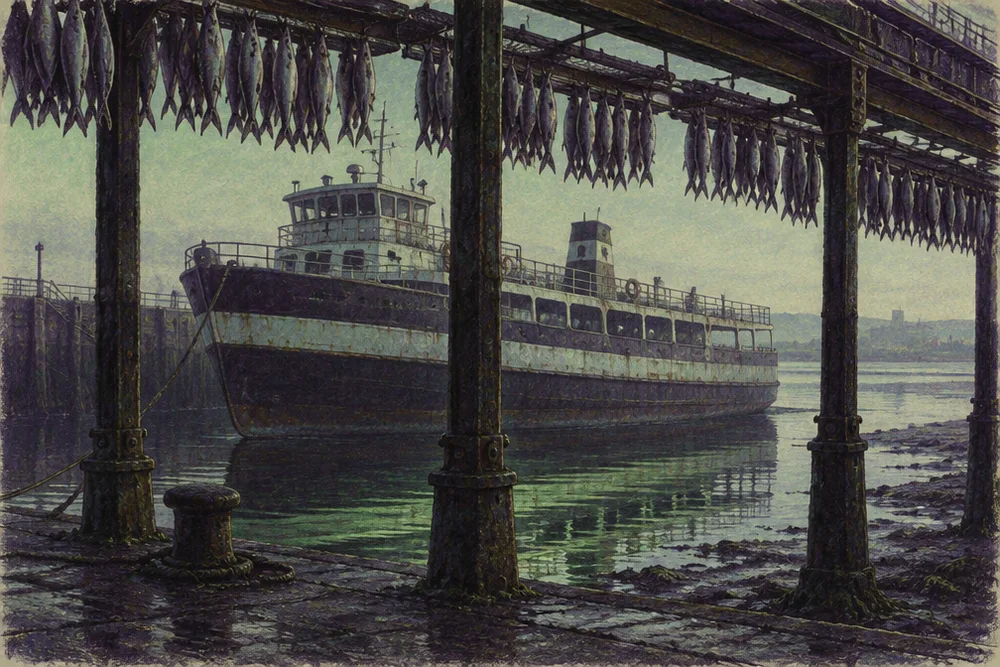
The Tongue Slip lay beneath the raised tramway, where the tide left a skin of mud shining between the posts. The boat sat on blocks well above the waterline. Its blunt bow was half hidden by stacked baskets; its deck had been taken apart years ago and fitted into drying racks. Fish hung in neat rows over the planks, silver bellies turned toward the weak light. A gull pecked at one eye and hopped away when Merryn came near.
She stood hip-first, one hand in the pocket of her square oilskin, and studied the boards. A row of bolt shadows crossed the wood beneath the fish: dark circles, each with a crescent of rust. She had seen that pattern on the ferry’s ribs when she first came to Sedgewick Reach. Three mismatched panels. The middle one longer than the others. A white depth stripe on the hull, faded but still there.
“You’re certain?” asked the man behind her.
Merryn turned. He wore a quay key on a cord at his waist and had the guarded expression of someone who’d been asked to give something up too many times. “The bolt shadows match the frame. The long panel goes forward of the middle seat.”
“There hasn’t been a middle seat in years.”
“Then we’ll have to remember where it went.” She looked back at the racks. “These panels are the deck.”
The quay keyholder gave a little laugh without warmth. “You’ve come to reopen a boat with a guess and a borrowed hammer?”
“I’ve come to ask for the slip.”
“Then ask the postmaster.”
“I did.”
“And he told you to ask us.”
“He said the keyholders release the landing.” Merryn kept her voice level. “He didn’t say I should ask twice.”
The man looked her over: narrow trousers damp at the cuffs, oilskin square at the shoulders, white seams of scarred skin across her thumbs. Her hands had the thickened pads of a boatworker’s, not the polish of a clerk. “We don’t give the slip to anyone who fancies a route. Zebedee has to recommend you.”
“He knows I’m here.”
“Knowing isn’t recommending.” The key swung against his coat as he turned toward the tramway. “You want a ferry, get the postmaster’s name on paper.”
Merryn watched him go. The landing keyholders held the quay households’ right to the slip, and the uphill tenants held little more than the work that kept those households supplied. She had heard it explained as practical custom, as if a custom became fair by lasting long enough. The grading workers could not store a boat. The quay could. The ferry had been out of service for years, but the key still mattered.