The Bridge That Remembered Otherwise
Page 6 of 8
The ferry bumped the step, and Ismay caught its rope. The woman in the bow stepped out with wet knees. “My father lives on this side,” she said, close enough now that Ismay could hear how out of breath she was. “I can see his washing from my house. To bring him soup, I go six miles round.”
Nella brought another load and then another. On the third trip the boy came, holding his mittens up to show he had kept them dry. The miller took the rope from Ismay after that, so she could go among the people waiting on the steps and ask what they wanted put to the vote.
The miller wanted someone to shut the bridge if the water rose high enough to carry logs against it. A far-bank stallholder wanted to know whether that was another way of saying she could be turned back with her cart. They talked until the miller fetched a stick and laid it across the steps.
“A mark on a pier,” he said, tapping the stick. “When the water comes to it, nobody crosses. Not even me with my meal getting wet.”
“And who goes out to look at it in the rain?” the stallholder asked.
He looked at her. She looked back. Finally he said, “One from each side?” She put her boot on the other end of the stick to stop it rolling.
The baker began handing out her bread in pieces. By the time she got to Nella, all she had left was a heel. She started to apologize, but Nella took it and bit through the crust.
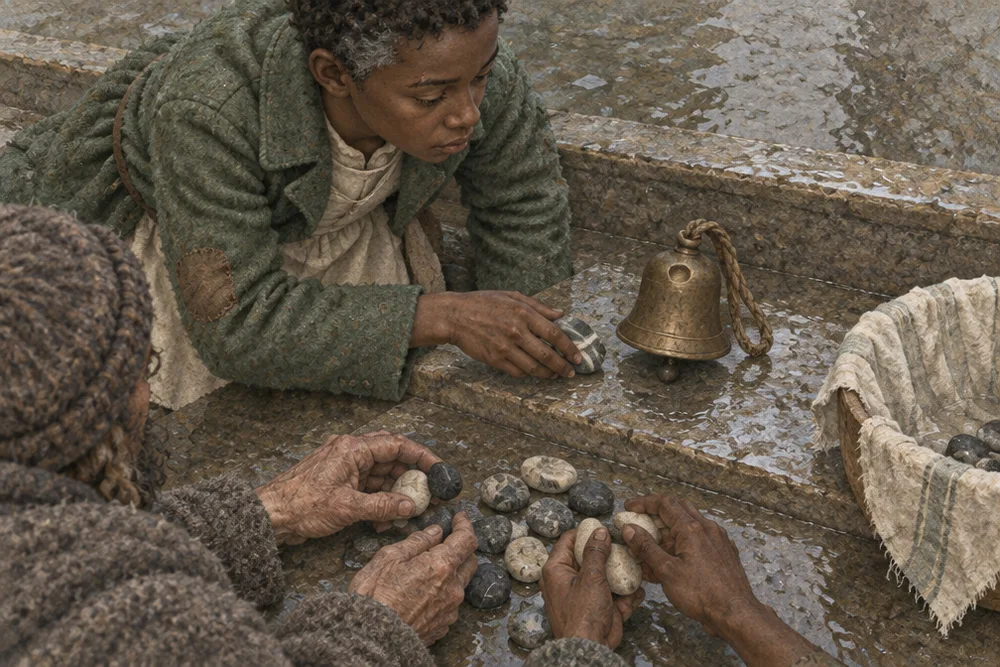
The elder with the mitten cord had brought the village voting bowl under his cloak. He set it down, then noticed that everyone could see into it. The baker turned her empty basket upside down, wedged it above the bowl on two stones, and hung the bread cloth across the gap. A hand could go underneath without anyone seeing what it held.
Ismay and the boy picked up river pebbles. Dark for no and pale for yes, the boy suggested. He found one striped down the middle and kept it out of the pile. “That's for when we haven't made up our minds,” he said, and put it on the step beside the bell.