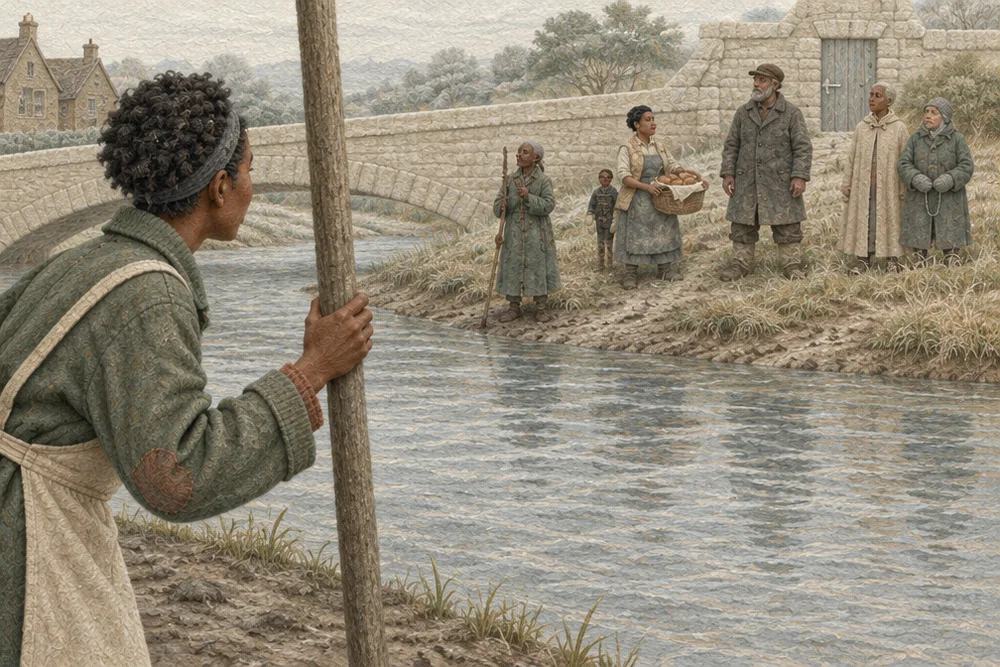
The Bridge That Remembered Otherwise
Page 2 of 8
“The flood,” said the miller. “That's what it wants. My father showed me where the water came up inside the mill.” He drew a finger across his chest, higher than Ismay would have liked to imagine water indoors. “It took the flour, the bins, and the ladder he climbed to get out.”
He stepped up to the latch and said, “We barred them because of the flood.” The latch sank until it lay flat against the wood. He tried to get a nail under it and couldn't.
“You can't bar a flood by barring people,” said the baker. “And if there'd been a vote, my mother would have baked for it. She baked for every meeting from the year she got her oven to the day her wrists gave out. There was never a vote.”
She said the last sentence into the wood. The latch came out again, but sideways. The baker let it be.
From the far bank an old woman called, “I remember being invited.” She was standing below the boy, on a shelf of mud, with one hand on a long ferry pole. “There was to be a supper to thank us for bringing people out of their houses. I had a clean collar for it. My aunt had washed it in the last of our drinking water, which she told me twice, so I wouldn't forget.”
The miller looked down at his boots. “People were brought out of the mill, too,” he said. “My father always said a boat fetched him off the roof. He never said whose.”
The baker lifted the cloth from her basket. Six round loaves gave up a little steam. “My mother told me how many she made for the flood supper. Forty. She said eighteen went stale.”
“Did you get to eat any?” Ismay called across.
“I didn't get as far as the bread,” said the old woman.
Ismay looked at the latch. It had righted itself while the old woman was speaking, but it hadn't lifted. Behind Ismay, up the frost-stiff road, the two elders were coming down from the village marker. The head elder walked so fast that her cloak opened and shut like a pair of shutters. Ismay knew that walk. It meant someone was about to be told what to do.