The Bell Rings Inland
Chapter 3 · A Seat for the Bucket
Page 24 of 227
Chapters
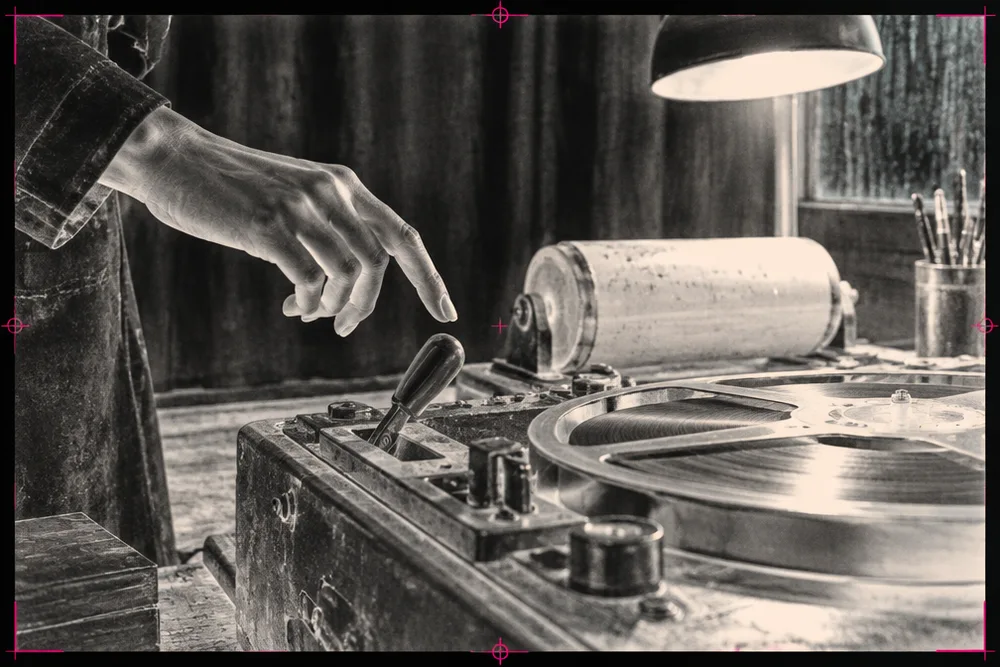
Nessa Valedew shut the Washhouse door against the wet wind and turned the brass key in its lock. “One playback,” she said. “No copies. No phones. If the wax starts to crackle wrong, I stop it.”
Quinn nodded. Her pink key loop tapped the side of her jacket as she moved to the worktable. Idris stood back from it, folded forward, listening even before there was anything to hear. Between them lay the cream paper jacket they had carried from Jaw Lane, its pencilled numeral darkened at one corner by drain water.
The Washhouse smelled of hot dust, damp wool and the metal tang of old tools. Nessa had cleared a patch of table among shoe lasts, a cracked kettle and jars of screws. She set the cylinder into a padded cradle with the care Quinn had seen her use on a split school chair. Then she looked at Quinn. “You know why I’m letting you hear it?”
“Because it came out of the drain after the bell,” Quinn said.
“That’s where it came from. Not why.” Nessa’s silver-threaded twists were clipped tight at her nape. She had her long black work apron on, and one hand rested near the playback lever without touching it. “Because I was there, and I want to hear what survived. You’re here to listen. Not to solve me.”
Quinn felt the warning settle between her ribs. “I understand.”
“Do you?” Nessa’s flat-tipped nose barely moved when she spoke. “Then don’t decide what I mean before I’ve said it.”
Idris glanced toward Quinn, but she gave him no answer to offer. Nessa lowered the needle. A faint rasp crossed the room, then a boy’s voice came through the speaker, thin and wavering, as if it had to travel through rain to reach them.
“There was a child sick over the rail,” the voice said. “Small one. Couldn’t have been more than six. I gave him my bucket’s seat, because the bucket was clean enough and the seat was dry. I held on to the rail instead.”
The recording fluttered. Quinn leaned toward the speaker, not wanting to miss even the spaces between words. The boy sounded young, but there was a steadiness to his phrasing that made Quinn picture someone trying hard to give an account exactly once.
“We were told the crossing was empty,” he continued. “That’s what the sheet said when Mr. Vale came round asking for the count. But I could see people on the outer quay. They were down by the sheds. They had bags and children. We brought some over. Not all at once. The little one sat where I’d been sitting.”