The Bell Rang Underwater
Page 256 of 266
Chapters
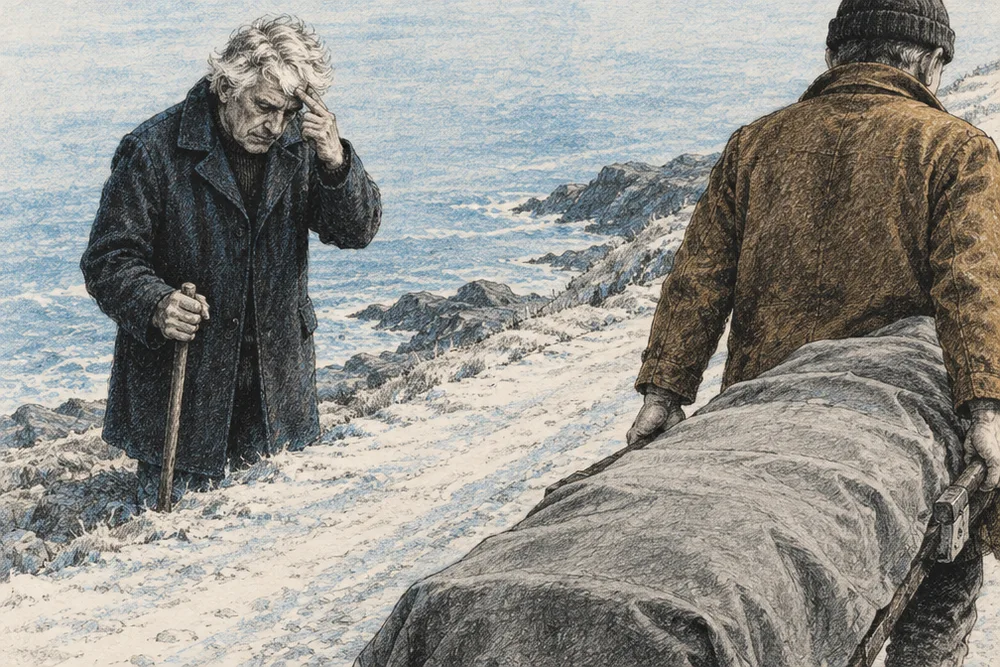
Jory Prowse stood a little way uphill, leaning his long frame against a walking stick. His patched waders were gone; he wore a dark coat buttoned wrong at the throat, and his injured hand rested inside it. The split in his left brow had healed into a pale seam. He watched the bearers pass, his hooded eyes lowered, as if every step crossed a mark he had once made in the wrong column. He had given his signed account to the inquiry and then repeated it in public, without bargaining for Kerris’s protection or Avelin’s forgiveness. The authority had suspended him from all reservoir work pending a sanction hearing. He had not asked Kerris to intervene.
When the first stretcher passed, Jory took his hand from his coat and touched two fingers to his brow. Not a salute exactly. Acknowledgment, or grief, or the last habit of a keeper who could no longer keep anything. Kerris nodded once. They had spent the weeks since the search speaking only when speech was useful: about access, about the route, about whether the investigators had secured the ledger’s chain of custody. Their silences had been less simple.
A small child walked beside the second family, holding a woman’s sleeve. The child glanced down the slope at the water, then at the covered stretcher. The woman bent and said something Kerris could not hear. The child nodded, and the two of them continued uphill. Kerris moved aside as the bearers reached her. One of them—an older man with a red scarf—looked at her squarely. “You found the place,” he said.
“You found your people,” Kerris answered. She kept her voice even, though the words scraped her throat. “The site was here before me.”
He took that in, then dipped his head. No absolution, no accusation. He turned with the others toward the cottages, where doors stood open and neighbors waited with kettles, coats, and chairs. The procession went on past the schoolhouse and into the town’s ordinary life. Behind them, the basin shone under a cold sun. The lower stair was under water again, and the old landing bell hung in a padded crate on the authority truck, its brass dull beneath a film of silt.
Kerris had asked for it to be returned to her only after the inquiry was finished with it. The request had been granted with a form, two signatures, and an inventory number. No one had offered to erase its place in the evidence record. She would not have wanted them to. The bell had rung through a drain, through a pipe, through the hidden routes of a valley that official maps had tried to smooth flat. Its sound had brought them to a site. It had not named the dead. People had done that.