The Bell for Unlisted Places
Page 268 of 304
Chapters
She recorded the clinic boat’s waiting time and the scow’s lost alternative. Her logbook had started as an inventory of missing approaches. It was becoming a ledger of what each choice asked from the people in the water.
When the first launch returned from the unlisted landing, the gray-haired passenger had gone ashore with his sister. The launch’s skipper held up two fingers, then pointed toward the channel. Clear. Ylva waited another minute for the wake to settle and called the clinic boat forward.
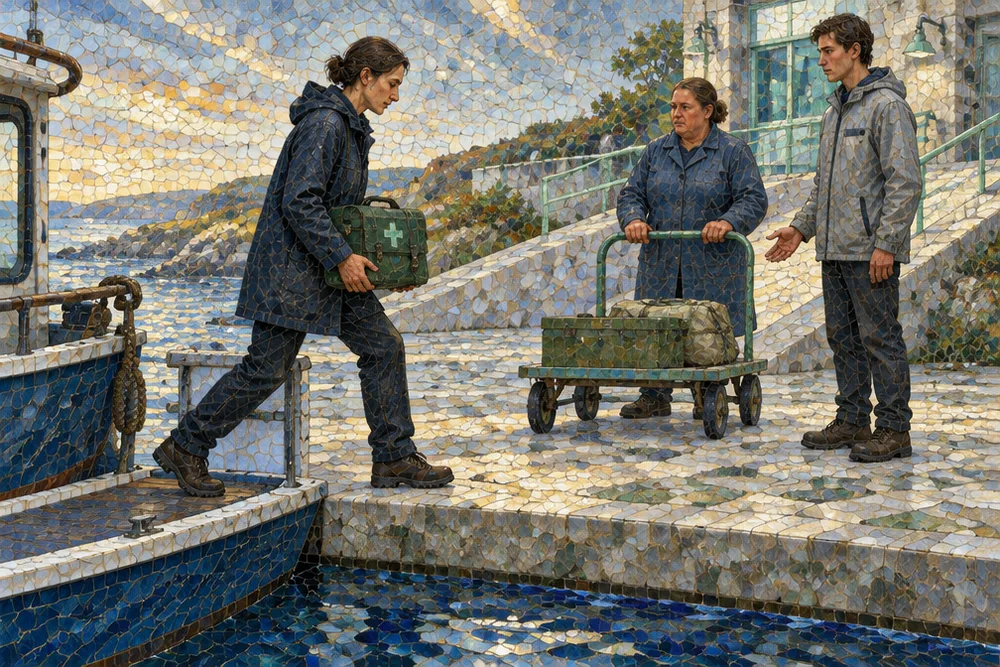
Its crew made the turn without touching the stone reef. The clinic worker kept the satchel tucked between both hands. At the ramp, a pair of attendants waited with a low wheeled trolley. The landing’s stone lip rose level with the boat’s deck, just as the shared line promised. The worker stepped across, and the attendants took the satchel. No one had to lift anyone over a gap.
Ylva marked the time. The clinic connection had been kept, but not by the old schedule. It had taken a patient call, a held freight load, and the agreement of strangers who had not yet learned to trust the chart’s new marks.
The next boat carried two net menders from a slip beneath the breakwater. Their invitation had come by hand signal from a lantern in the fog, then been confirmed by a woman aboard who knew the household. Ylva asked the woman to speak the address. She did. The bell’s note traveled over the water, brief and clean. A line appeared on the chart, and the two menders’ boat crossed to the landing without pressing against another approach.
By midmorning, boats were moving through the refuge lane at intervals. The rhythm was slower than a listed route and less orderly to look at. It depended on people calling, answering, checking their neighbors, and holding back when the water could not carry two turns at once. Yet the shared marks remained lit. No landing had vanished when the next boat left.
Ylva watched the channel mouth. Each time a boat departed, the available water seemed to widen by a fraction, as though the harbor were learning not to confuse ownership with passage. She did not trust that feeling. Tides changed; stone moved; crews grew tired. A route that worked once could still fail the next time someone came in heavy and impatient.
The freight scow remained at the back of the queue, its oil drums secured under rope. The skipper had not left, and his crew had not abandoned the work. The tide window was narrowing. Ylva could hear the engine idling whenever the wind shifted.