The Bell for Unlisted Places
Page 206 of 304
Chapters
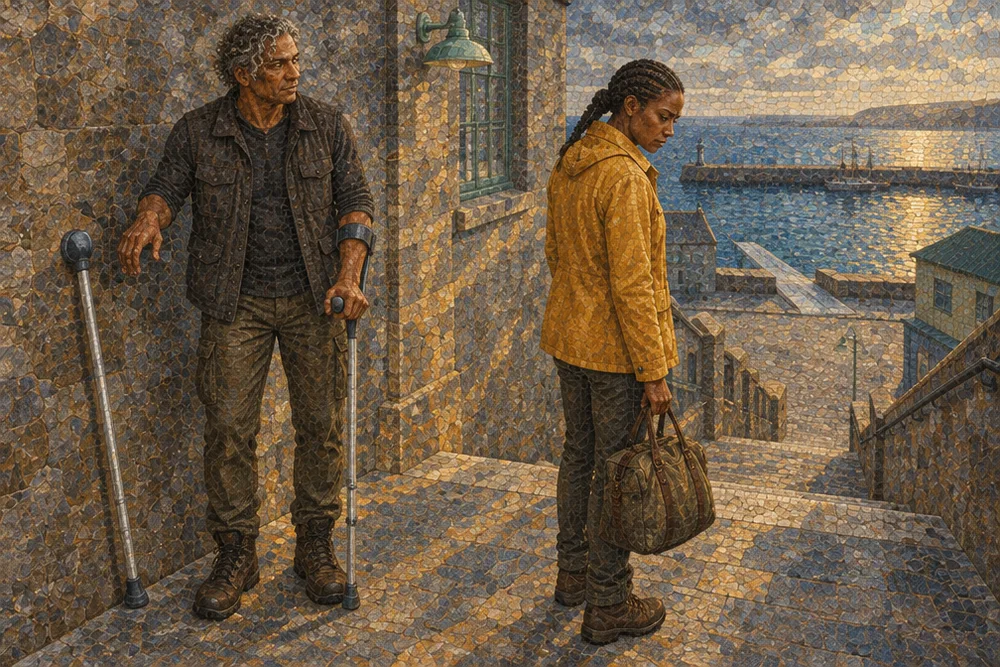
The first flight had been built from smoky-gray blocks, their edges rounded by weather and the drag of handcarts. Orren chose the outside rail, where the stone wall gave him room to set a crutch without knocking it against Ylva’s shin. She kept pace beside him, not in front. From below, the harbor bowl opened in pieces between the buildings: a slice of lapis water, the carnelian beacons at the lock, a strip of foam trembling against the quay. “You’re measuring me,” he said when they reached the landing. “I’m measuring the stairs.” “That’s worse. Stairs have had centuries to defend themselves.” She looked at the next flight. Its steps narrowed near the top, where old patchwork had raised a lip across the stone. “Your left crutch catches there.” “Then I’ll put it on the other side.” He demonstrated, shifting his grip, and went up. Ylva watched his broad palms tighten around the handles. She wanted to reach for his elbow. She wanted to make the hill disappear. Instead, she carried the bag and let him set his rhythm. At the next landing, a porter pushed an empty handcart downward, the wheels clattering over each step. He stopped to let them pass and glanced at Orren’s crutches. “Clinic?” “Unless the hill’s moved,” Orren said. The porter smiled, then lifted the cart by its handles to clear a chipped stair. Ylva saw his right wrist tremble with the effort. She wondered how often people took this route because the chart had decided which boats deserved space. “The east ramp would be easier,” she said after the porter was gone. “For me,” Orren answered. “And for the woman with the cart. And for the boy who can’t be late to the clinic because his mother’s shift starts at noon. That’s why a ramp matters.” He rested one crutch tip against the wall and flexed his fingers. “But you cannot make one boat’s first call into a private stairlift. Not if the bargain is that nobody else can call for a landing.” Ylva looked down the steps. At the bottom, the road curled toward the water; beyond it the ramp was a narrow pale line against the quay. The morning ferry, if it kept its promised run, would meet the clinic landing before the clinic doors opened. She had imagined that run as a solution: one reliable approach, one scheduled boat, her name on its wheel. She had not imagined everyone else waiting while the route made good on its promise.