The Bell for Unlisted Places
Page 16 of 304
Chapters
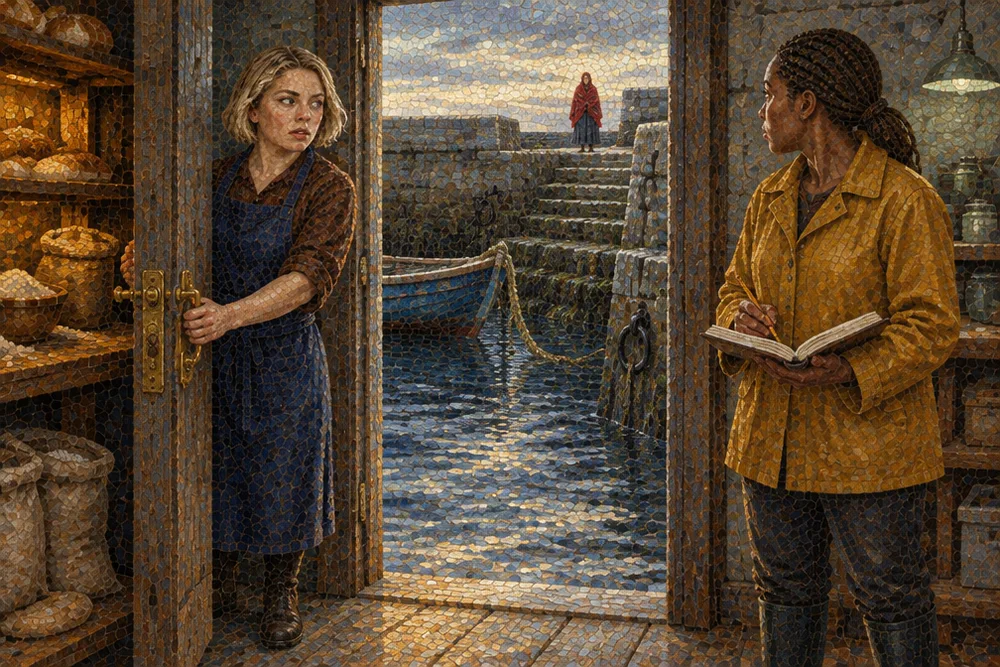
The door swung inward on a low creak. Beyond it lay no yard, no drain, no wall. A narrow slip stretched between the bakery and a line of houses, its uneven stones descending to a strip of water. The tide there was low. Mooring rings, black with age, were set into the quay edge; one held a loop of frayed rope. Across the channel, a landing clung to the side of a building Ylva had never seen from the harbor.
She stopped with the pencil point resting on the page. The air from outside carried fish smoke, wet rope, and the faint sour smell of old seaweed. It was not a painted scene or a trick of reflected light. A small skiff moved under the opposite landing, rocking in the slack water. A woman in a red shawl stood on the steps above it, watching them.
Sella’s hand tightened around the latch. “You see it.”
“Yes.”
“I asked you that yesterday, once. You said you didn’t know what I meant.”
“I hadn’t seen it.” Ylva leaned a fraction toward the open door. The paving stones were real enough to show pale chips and dark joints. She could hear water clicking against the skiff’s boards. “Where does it lead?”
“The old back slip. To the houses beneath the breakwater.” Sella did not sound relieved to have been believed. “There are people there.”
Ylva wrote the words carefully, then looked at Sella. “How many?”
“That depends on who’s asking, and what they want to do with the answer.” Sella’s gaze held on the page. “The harbor stopped listing the slip before I started baking here. My door didn’t get the notice.”
Ylva had learned to test a landing before stepping onto it. She put one boot on the threshold, pressed down, and felt the wood answer with a familiar flex. Beyond lay stone, not water. Still, she did not cross. “May I?” she asked.
Sella’s eyes flicked from Ylva to the distant woman. “You may look. Don’t call out, and don’t go beyond the first ring.”
“I won’t.” Ylva set the logbook on the flour shelf and took a short length of spare line from her belt. She looped it around the iron handle inside the bakery, leaving enough to stand on the step. Then she walked through the doorway.
The air changed. The warm, yeasty room fell behind her; the slip’s damp chill settled over her cheeks. She turned and looked back. Through the open door she could see the storeroom, Sella’s elbow, the flour sacks stacked beneath the shelves. The threshold did not shimmer or blur. The two spaces simply met, as though the bakery had always possessed another rear wall.