The Bell for Unlisted Places
Page 137 of 304
Chapters
Rusk pointed her toward an empty place. “There’s room. If you don’t mind sitting beside the rudder.”
The damaged timber lay along the wall, stripped of its metal fittings. One edge had split in a pale, ragged seam. Ylva set down the loaves and took the place. Around her sat the people who had brought the ferry back from the turn: Rusk, his assistant Pela, two deckhands from the listed fleet, and Iven, who had washed his hands but not quite removed the pitch from beneath his nails.
No one began by talking about the accident. They passed bowls and broke bread. The stew was thick with barley and pepper, and the stove’s heat loosened the chill in Ylva’s fingers. Pela told a story about a mooring rope that had frozen to a bollard in a year when the harbor’s water had steamed at dawn. Rusk corrected the year. Iven corrected the rope.
“You all keep records?” Ylva asked.
“Of disasters?” Pela said. “Only the memorable ones.”
“Of repairs,” said Rusk. He tapped the table with his spoon. “Of what fits where. Boats have a way of making you learn the same lesson repeatedly.”
Ylva opened her logbook, then stopped. She had meant to record the damage as a measurement. The stern had swung three handspans farther than she’d expected; the tiller had resisted; the turning basin had seemed narrower than its charted width. But the meal around her was its own kind of measurement: how many hands were needed to bring a boat home, how long it took for blame to soften enough to be swallowed with stew.
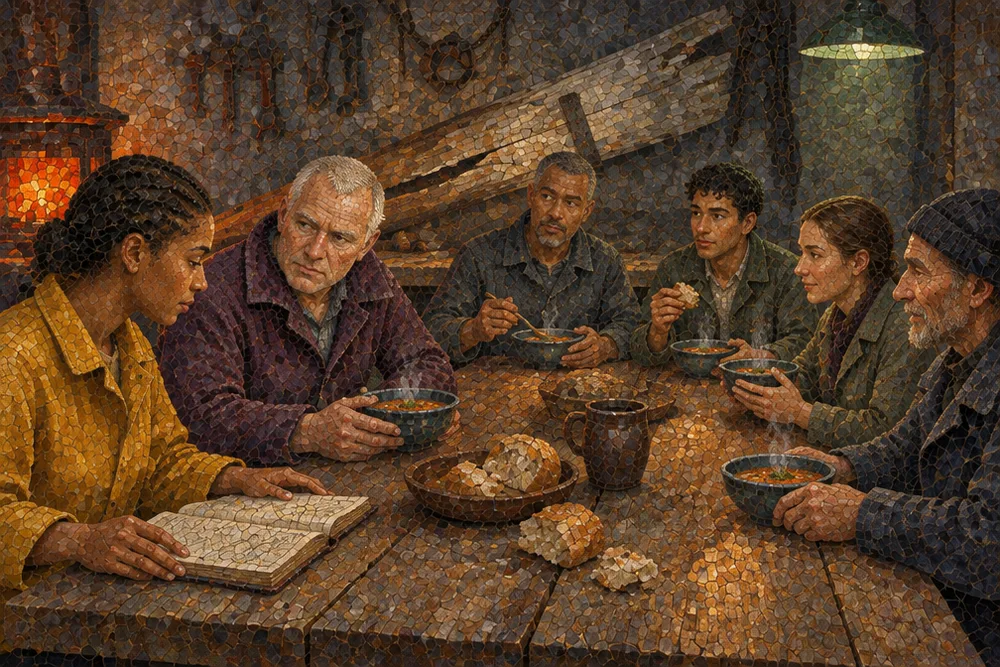
Iven glanced at the open page. “Don’t put in that I was right.”
“I wasn’t going to.”
“Good. It would be a poor record.” His eyes crinkled, though his square face stayed serious. “Write that the channel gave us less room than the chart promised.”
Ylva wrote it down. The sentence looked different from a number. It named a condition, not a failure.
After supper, the crew returned to the ferry. The stove was banked, but Ylva stayed behind to help clear bowls. She heard a scrape from the far end of the shed, followed by Rusk’s sharp whistle.
“Come look at this.”
A stack of spare planks had been shifted away from the inner wall. Behind them, the stones were marked with shallow grooves, nearly invisible beneath years of soot and limewash. Rusk held a lantern close. Its amber light ran along two long parallel lines, then caught a row of smaller notches between them.