Supper Before the Footbridge
Page 98 of 204
Chapters
That afternoon, two of the younger children came to school with their mother. The woman had brought a small parcel of mending to deliver to the west bank and was willing to make the crossing while the tide was low. She asked Catrin whether she could keep the children until the ferry returned. Catrin did. In the book she wrote “present, part day,” though she knew the phrase would not show that one of them had arrived with a wet hem and the other with a loaf tucked under her coat.
The boys had walked the six miles before, their mother said, but not in winter, and not while the mill cart used the lane. “You can take a child along the road,” she told Catrin. “You can’t take all of them, every day.”
Catrin recorded the words on a separate sheet, with the woman’s permission. She did not put quotation marks around them. They were not evidence of a fixed number or a rule; they were a household’s account of its own choices. She was learning that the most convincing statement might be the least useful if it claimed more than the speaker could know.
On the third day, Nell arrived after the afternoon lesson had begun. Her cheeks were bright from the wind. She had an empty lunch cloth folded in one hand and the mill’s pay mark on her wrist, a small smudge of blue chalk. Catrin paused the reading exercise.
“Did you cross alone?”
“No. My mother came with me.”
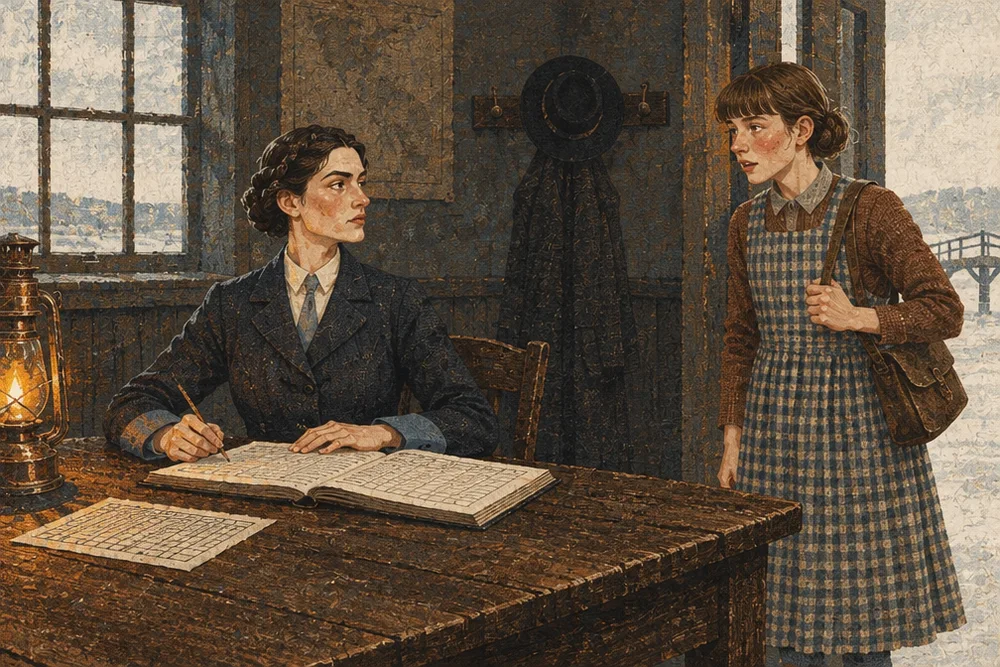
“Will you be able to come tomorrow?”
Nell shrugged. “They’ve put me on the early sorting. I won’t be done till after school.”
Catrin made the note, then felt the weight of it. Nell was not a number on a page. She was also not a symbol to be carried into a committee room as if her life had been arranged for an argument. Catrin shut the register.
“You can read with me after lessons today,” she said. “Just the two pages you missed.”
Nell looked at the open book. “If I can get back before the tide turns.”
On Saturday, Catrin walked the eastern lane from the cottages to the ferry landing, counting the places where a child might be forced against the mill wall to let a cart pass. The mud had dried in ridges. At the lowest bend, the flood had left a dark line on the stonework shoulder-high to a small child. She noted the marks and distance, not because they proved the lane always flooded, but because they showed where water had reached in the winter just past.