Supper Before the Footbridge
Page 95 of 204
Chapters
Catrin had no answer ready. She could petition the managers again, but they had already warned that if attendance continued to fall they might reduce the school’s paid staff. She could ask the mill for a different hour, but Ivo had closed the one room she had been given. She could take the children to the quay, or the church porch, or a cottage kitchen, yet none of those places altered the distance between the banks. Each solution depended upon the same children finding their way through the same hazards.
“I’ll find out what the records say,” she answered.
Nell’s mouth tilted. “Records don’t get wet.”
“No,” Catrin said. “But they can show how often you do.”
The next morning Catrin asked Edwin Prowse for the ferry’s fare book. He received her at the landing office, a low room smelling of tar and damp rope. His bottle-green coat was buttoned high, and a watch chain crossed his waistcoat. He stood with his heels together, a habit that made him seem smaller than he was, though his hips filled the narrow space between desk and stove.
“I can give you the totals,” he said. “I can’t lend out the book.”
“I don’t need to take it away. I need to see the dates.”
“The dates are mine to account for.”
“The crossing is part of the school question.”
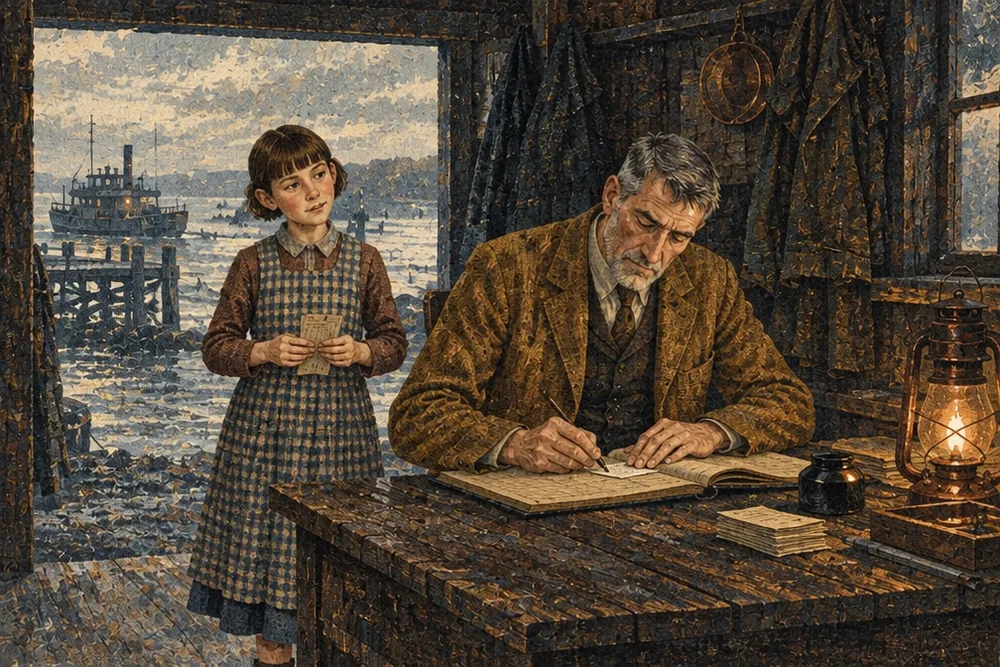
“It is part of the ferry question, too.” Prowse lifted a ledger and opened it to a page ruled in blue. “I’m not refusing you. But there are claims pending, and I won’t have a page passed about the village before I’ve made my return.”
Catrin waited while he copied the numbers onto a slip. She had seen him at the hearing, heels together before the commissioners, where his answers had been careful and short. His livelihood depended on the ferry, but so did the village’s ability to cross. He had reopened it on a limited schedule after the flood, and every passenger brought him a coin or a reason to keep the service going. Neither fact made him impartial. Neither made him wrong.
“You have fewer crossings in January,” she said, studying the figures.
“The tide was against us. Then the river rose again.”
“And in February?”
“Some days I didn’t run.”
“Why?”
He shut the ledger. “Because the landing was slick. Because I had no second man. Because a boat doesn’t become safe just because a schoolmistress needs it.”