Supper Before the Footbridge
Page 8 of 204
Chapters
The schoolroom was quiet. At the far end, one of the children’s readers lay open on the bench, its thin pages bowed from damp. Catrin closed it and returned it to the shelf. Outside, the bell rope hung against the wall, still and dark. Across the river, a lantern showed briefly near the mill, then disappeared behind a cart.
She would need a builder to inspect the abutment. She would need the mill to say whether a strip of its yard could be used. She would need to make the children’s absences legible without turning them into a plea that asked the commissioners to overlook other people’s needs. And at the hearing she would have to listen before she wrote.
The hearing date came on a folded note, with no account of who else would attend. Catrin pinned it above her desk. She wrote to a builder in the next parish asking for the cost of inspecting the abandoned abutment, and to the mill office asking whether someone might walk the eastern approach with her. She kept both letters formal. A bridge was not yet built by a hopeful tone.
For the rest of that week, the crossing remained closed. The children came when they could. Nell arrived twice, once on a cart and once by the long road, her shoes grey with road dust. On the other days, Catrin marked her absent and left the reason blank. She did not write mill beside the girl’s name unless Nell told her so.
A rumour came by way of a grocer’s boy that the mill foreman had been seen at the pay shed on the night of the flood. Another came that the ferryman had kept his lantern lit until the bell. Both versions ended with the same certainty: someone else had heard it too. Catrin entered neither in her notes.
When the surveyor finally replied, he wrote that he could inspect the abutment on a market morning, weather permitting. He did not give a price for construction. Catrin read the letter twice and placed it behind the petition. A beginning was not an estimate, but it was better than the blank space.
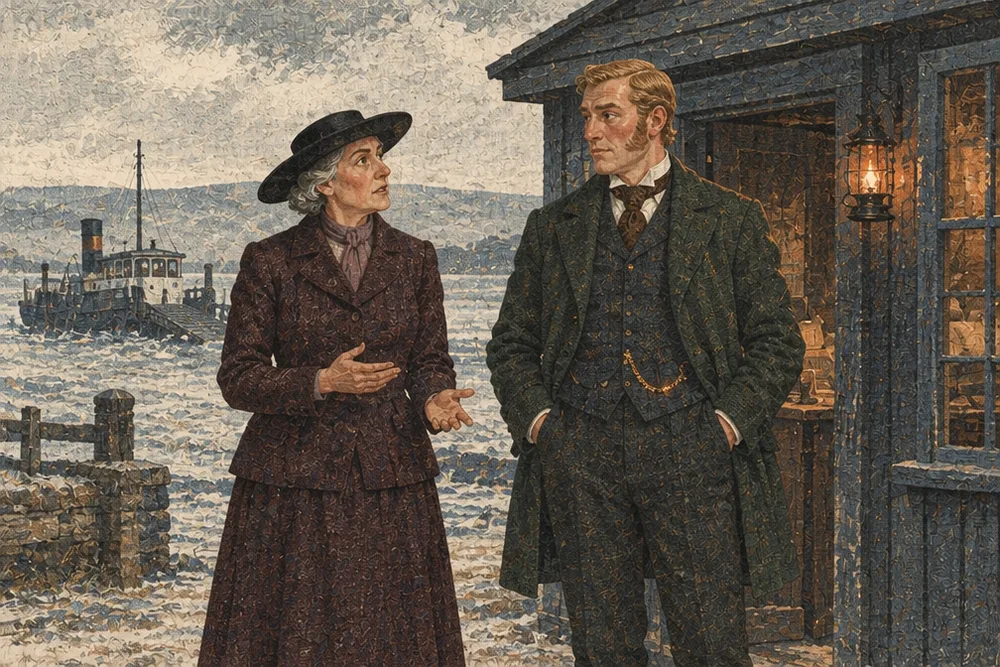
On Saturday she went down to the quay to speak with Edwin Prowse. He was standing by the ferry office in his green coat, watch chain glinting when he moved. He heard her out, heels together, small hands folded over his middle.
“A bridge would take trade from the ferry,” he said. “There’s no use pretending otherwise.”
“It would also carry people when the ferry cannot run.”