Supper Before the Footbridge
Page 65 of 204
Chapters
Once the door had closed, Catrin reviewed the passages from their beginnings. She took out the language that suggested Fenella had watched the lantern continuously; Fenella had not said that. She corrected a verb that made Ivo sound as if he had seen the lantern extinguish. He had seen it light, then noticed it dark. A difference of two words, and the whole account stood more honestly.
She copied Fenella’s admission in the same hand as the rest, not smaller, not tucked into a footnote. She included the reason Fenella had given: she wanted her husband home for supper. She wrote nothing about what the husband might have understood, whether he had seen the dark lantern, or why he had gone back to the landing. The hearing had established none of those things.
The temptation to summarize returned with each line. The commissioners could not spend all day in the schoolroom. Their subscription had to be allocated; the households had to know whether money was coming. A clean statement might let them act quickly. But clean was not the same as true. If she compressed the passage, she might erase the one thing that explained why the lantern had been put out, while leaving the commissioners to infer its meaning for themselves.
Catrin dipped her pen. On a separate sheet she wrote a heading: “Matters agreed.” Beneath it she listed the ferry’s mooring, the flooded lane, and the single stroke of the bell. Then: “Matters differing.” She described Fenella’s placement of the bell before the lantern’s darkness and Ivo’s placement of his notice of darkness after the bell. She made no statement about which order had occurred.
At the bottom she added: “Mrs. Letham stated that she herself extinguished the lantern, intending that her husband should return home for supper. Mr. Marr stated that he did not observe the extinguishing, but noticed the lantern was dark after hearing the bell.”
It was not elegant. It was not a ruling. It did not tell the village which version to repeat. The words kept each person within the bounds of what they had said, and no further.
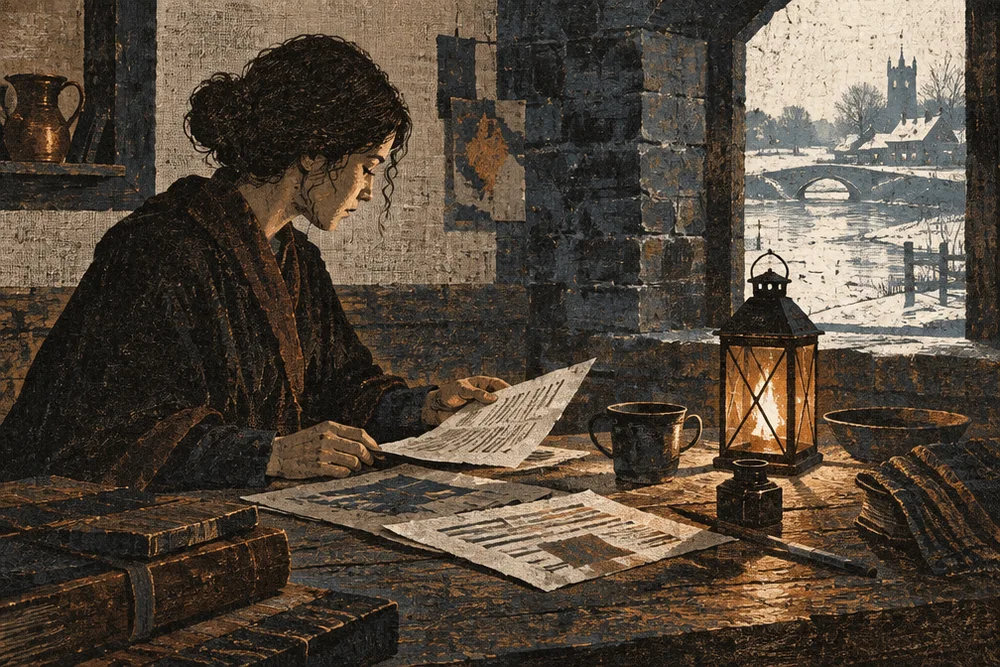
Catrin folded the rough notes into the file and carried the fair copy to Agnes. The commissioner sat alone at the table with the subscription accounts. A coal shifted in the grate and fell with a soft clink.
“Both witnesses have heard their passages,” Catrin said. “Neither asked for a change.”
“And the admission?”
“Included. Attributed to Mrs. Letham.”
Agnes extended her hand for the pages. “Then let us see whether the record can bear what we ask it to bear.”