Supper Before the Footbridge
Page 44 of 204
Chapters
She had expected that a fair copy would feel like a conclusion. Instead, it felt like a door held open on a draughty passage. At the far end might be relief payments, or a bridge proposal, or an empty sum and another term of missing pupils. The record itself could not determine what the committee would choose. It could only keep the choice from resting on a false certainty.
The next morning, Ivo came alone to hear his statement. He sat in the chair nearest the door while Catrin read it aloud. At “the lantern was no longer visible,” he interrupted.
“I said the light went out.”
“That is what I have written.”
“No longer visible can mean it was hidden.”
She drew a line through the phrase. “You’re right. I’ll use your words.”
He listened to the rest without comment. When she finished, he said, “That is what I remember.” He signed beneath the statement, his signature slanting forward like his posture.
Fenella came after him. She stood while Catrin read, one hand resting against the back of the chair. At the sentence about the supper, she lowered her eyes. Catrin waited until she looked up again.
“You have my admission,” Fenella said.
“I do.”
“And the other thing?”
“That you saw the light after the bell.”
“Keep both.”
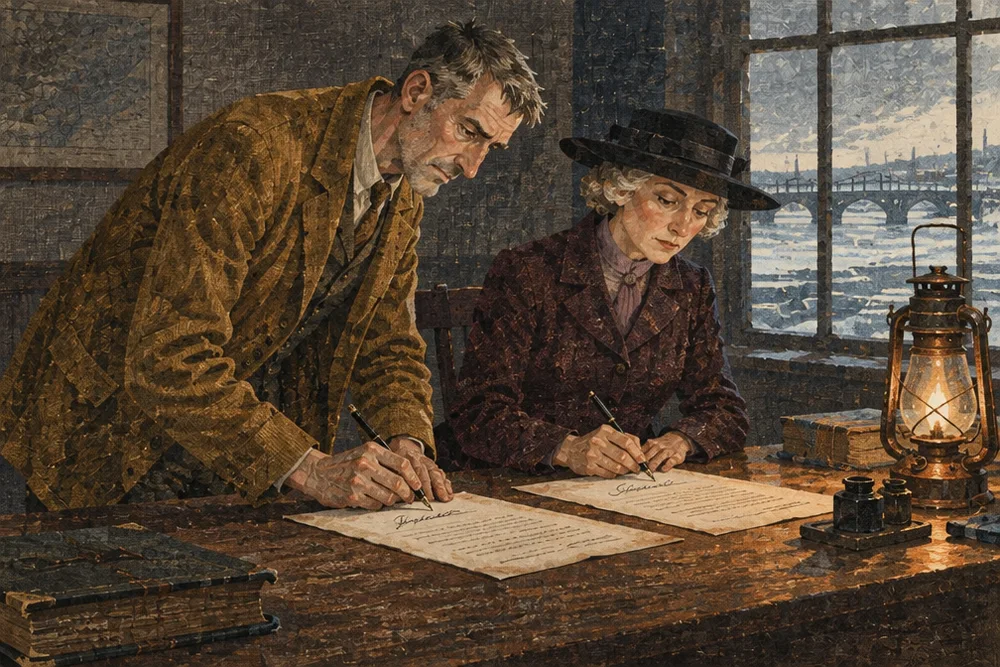
Catrin set the pen before her. Fenella signed. Her hand was steady until the final stroke, where it lifted from the page with a small, rough scrape.
The committee would meet again with the record in front of it. Whether the fund could pay for relief, whether a bridge might be proposed, whether the school could keep its doors open: none of those questions had been answered. Catrin sanded the signatures, shook the grains carefully away, and placed the signed pages together without folding them.
Agnes returned before the committee session and read the completed record at the teacher’s desk. She took her time. Once, she moved her finger back to the paragraph describing the lantern and read it again. At the end she looked at Catrin.
“You have kept the observations separate from the conclusions.”
“I tried to.”
“That is sufficient.” Agnes signed the last page and passed it to the parish clerk, who added his name as witness to the proceedings. The signatures did not make the sequence clearer. They made the uncertainty official.