Supper Before the Footbridge
Page 26 of 204
Chapters
She could not persuade a line on paper to make space where there was none. At last she left the route straight and marked the fence on both sides. At the eastern end she drew a gate, its opening facing the cottages, and wrote beside it: “Mill access to be determined.” She disliked the phrase because it had no edge. It could hold a useful agreement or an exclusion, and did not tell the commissioners which one they were buying.
When the school manager, Mr. Crewe, came to inspect the estimate, he traced the river with one blunt finger. “Couldn’t the bridge be placed nearer the quay? A gate at the mill will make people say it belongs to the mill.”
“The survey rejects the quay landing,” Catrin said. “The silt shifts underfoot.”
“Then say the mill must keep the gate open.”
“I can propose that. I cannot pretend they have agreed.”
Crewe frowned at the estimate. “There are children who need lessons. If a condition has to be softened to get the money, perhaps it ought to be softened.”
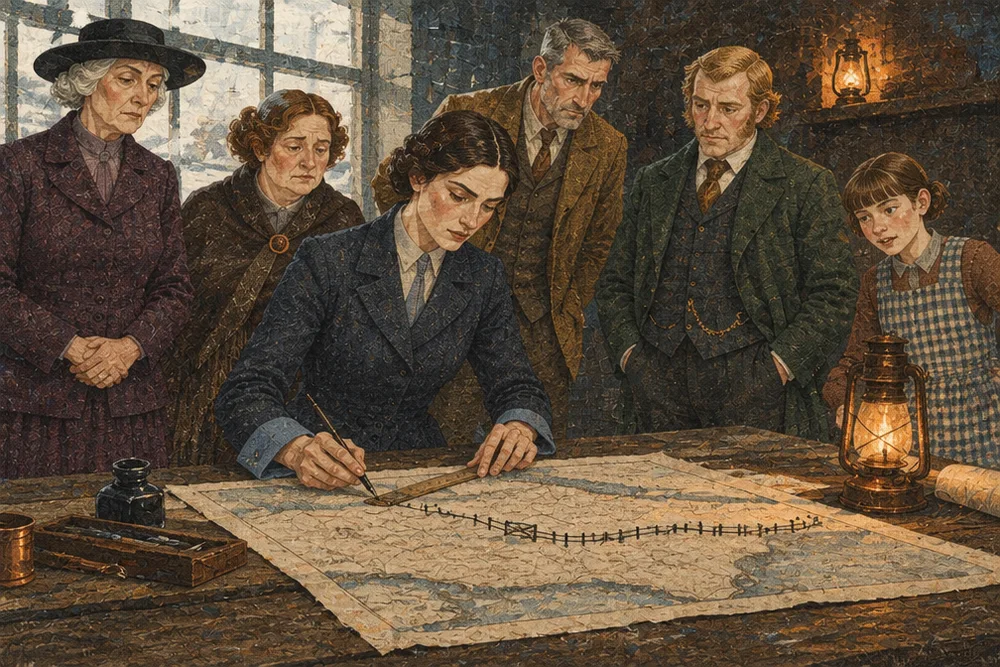
“A condition is not a fact.” The words came out sharper than she intended. She made herself look at the paper rather than his face. “The mill has asked for the right to close the path. That must be heard. The bridge can be cheap and still fail to serve the children.”
He gave a small, dissatisfied breath. “You make no friends with that distinction.”
Catrin thought of the forthcoming hearing, of the two witnesses who agreed on almost everything except the order of the warning and the darkening lantern. She thought of what a neat record might do: turn a possibility into certainty, a preferred result into a remembered event. She had not yet made a choice about the transcript, but she could feel the shape of the temptation.
“I am not making a finding,” she said. “I am stating the terms we have.”
Crewe took his hat from the peg. “See that the bridge is not lost while you are being exact.”
When he left, the schoolroom seemed unusually quiet. Catrin rolled the plan carefully and placed it beside the fair copy of the estimate. The short route was the cheapest, and the only route that made practical use of the old abutment. It passed through the mill’s eastern approach. If the committee approved it, children would cross under a condition they had not chosen; if it refused, they would keep waiting for weather, tides, or a six-mile detour.