Supper Before the Footbridge
Page 20 of 204
Chapters
The path upriver followed the edge of the millpond, then climbed above a patch of reeds where floodwater had deposited twigs and straw. Catrin’s long stride carried her ahead of the surveyor until she noticed the difference and shortened it. He was watching the ground, not her, testing each hollow with his staff.
The abutment appeared beyond the mill’s stone yard: two squat blocks of old masonry, their faces furred with lichen, with a gap between them where the cart road had once crossed the stream. Water ran below, quick and brown from the recent rains. The eastern block stood within the mill’s boundary, the western one on parish land. The narrow channel was not the river’s main course; a footbridge here would avoid the silted landing and the strongest tidal current.
The surveyor set down his rods and knocked the stone with a small hammer. The sound was firm in some places and hollow in others. He climbed the eastern block, crouched, and brushed earth from the top. A line of dressed stone emerged beneath the moss.
“This is better than the quay,” he said. “If the core is sound, you’ll need only to renew the cap and put your deck across. The old footing takes the weight. It saves you the piles.”
Catrin unfolded her plan on a flat stone. In the blank space she had marked a straight line from the school to the abutment, then a dotted track onward to the east-bank lane. The surveyor leaned over it, his finger following the proposed approach. He stopped at the millyard boundary.
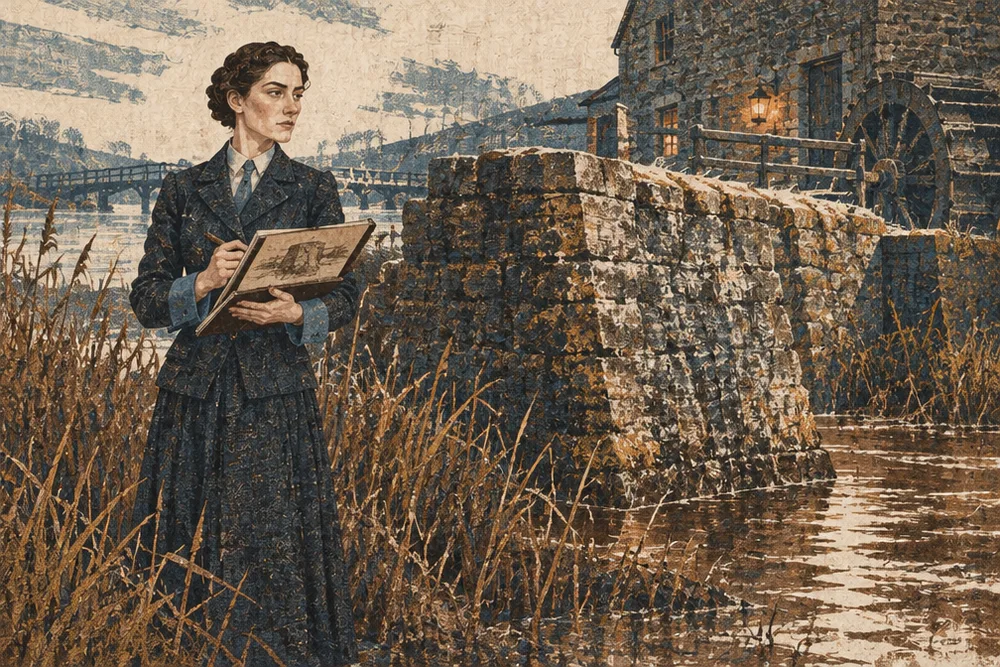
“You must get the mill’s agreement for this end.”
She had expected that. The mill owned the yard and controlled the narrowest way from the abutment to the lane. Without a path through it, the bridge would deliver children to a wall and locked gates. “The approach can run along the outside,” she said.
“Not without taking in the cart track.” He pointed to the wheel ruts, worn hard beside a stack of timber. “The carts swing wide here. You’ll need a strip inside the yard, or a diversion around the buildings.”
A diversion would bring the route down toward the flood lane and add both distance and cost. Catrin looked across the yard. Men were loading sacks from a low shed; at its far end, an iron gate stood between the mill and the cottages. A chain hung from the gate, looped twice through its bars. The school route could be made in that direction, but only at someone else’s permission.