Supper Before the Footbridge
Page 197 of 204
Chapters
Inside the schoolroom, the stove had begun to warm the dry walls. Catrin laid out the attendance book and a fresh slate. Nell put her hands near the stove but did not stretch them out. She had come to learn; that was not the same as being able to stay.
The rest of the pupils came in by the ordinary routes: two from the west quay, three from the cottages above the chapel, and a pair of brothers who arrived arguing over a string of eel baskets. Their boots stamped grit across the floor. The room filled with the low, familiar work of settling—slates lifted from pegs, caps pushed into pockets, a cough smothered in a sleeve. Nell took a place near the window, where she could see the eastern approach without turning her whole body.
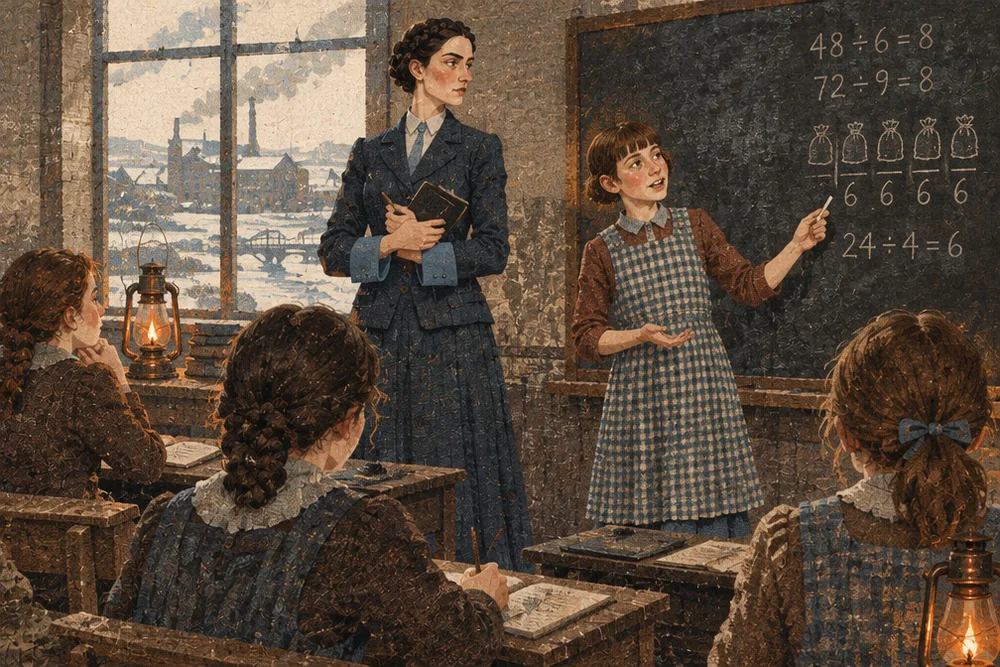
Catrin began with sums. She gave the class a problem about a load of barley divided between sacks, and Nell’s hand rose before the others had finished copying it. She worked the answer in the margin, then erased it when Catrin asked her to explain. Her reasoning was sound. She had counted sacks at the mill, and understood that one split bag could spoil the reckoning of a whole cart.
“If there are thirty-six sacks,” Nell said, “and four to each stack, that is nine stacks. But if one sack leaks, you must count what remains, not what the paper says was delivered.”
“Exactly,” Catrin said. “The paper is a record of what someone declared. The grain is what you can inspect.”
Nell’s mouth tightened in concentration. “And if you can’t inspect it?”
“Then you write what you know, and how you know it. You do not make a thing true because it would help the account.”
For an instant Catrin saw the hearing room as it had been: Agnes Bellord at the table in her plum wool, shoulders squared; Ivo Marr leaning forward, long neck bent over his statement; Fenella seated back in her chair, copper pin at her shawl. The single bell stroke. The lantern. One witness placing the sound before the darkness, the other after. Fenella’s admission, carefully spoken, that she had put out the light to call her husband home to supper. The record had not chosen between them. It had not awarded a bridge. The bridge had come by a different road, built from fares, pledges, timber offcuts, and conditions everyone had to accept.
Catrin set the slate on Nell’s desk. “Keep that line. It may serve you in sums and elsewhere.”