Supper Before the Footbridge
Page 167 of 204
Chapters
He studied her as if he had expected a plea for a faster promise. Catrin did not offer one. “I will,” he said. “But if the bank turns soft under the new pier, I stop. I won’t have the village claim I said otherwise.”
“Put that in too.”
The mason, working near the abutment, glanced up at their voices. Behind him the hollow had been braced with rough boards. A strip of red string marked where the new footing was meant to stand. The work had begun, but not yet in a way that could be called a bridge.
Ivo joined them from the pay shed. “The mill can release the lengths we promised,” he said. “Not the whole stack. I need the rest for the repair frames.”
Catrin opened her notebook. “Which lengths?”
He told her. She wrote each one down, then asked whether the yard crew could cut the ends to the sizes Hales required. Ivo said they could, but not without taking time from the mill’s own work. They agreed to put a value against the labor rather than disguise it as a free gift.
It was a modest agreement, and neither man smiled. Still, the numbers in Catrin’s notebook settled into a more possible shape. Material, labor, cash, dates: each had to be named separately before they could be added.
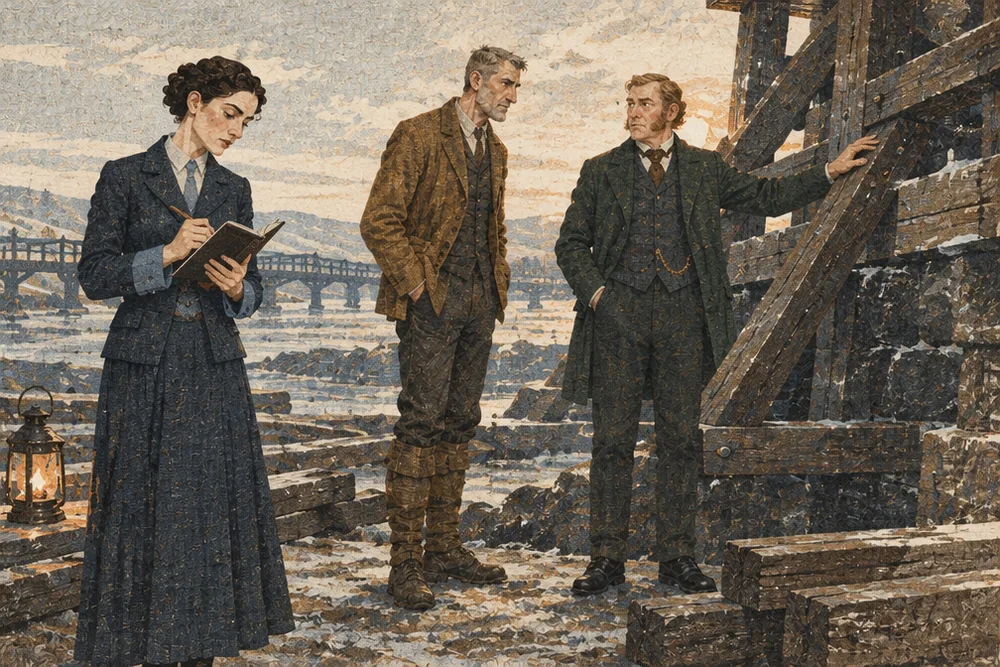
At the gate, a carter called to Ivo about a delayed load. The foreman turned away to answer. Catrin heard the horse’s harness creak as it shifted its weight, and saw the dray swing wider than it had the day before. The proposed raised ramp would take some of that turning space. The route would have to be marked carefully, and the fence strong enough to protect a child without being set where it caught a wheel.
Hales took his drawings back under his arm. “You will have a new contract schedule by Monday.”
“And the cost?”
“The revised price stands, subject to the footing. No lower deck.”
Catrin repeated the phrase in her notebook. No lower deck. It sounded like refusal, although it was also the first firm thing she had been able to secure.
Before returning to the schoolroom, Catrin crossed to the quay and looked upriver at the abandoned cart abutment. From there the water seemed quiet, its surface broken only by a line of pale foam caught against a stone. The working ferry’s landing lay farther downstream, where the old lane met the tide. The bridge would not stand there. It would rise from ground the village had once left to weeds and nettles.