Supper Before the Footbridge
Page 164 of 204
Chapters
Catrin read the columns twice. “Could we use the old stone for the facing?”
“Some of it. Not the core.”
“And the low deck?”
“As I told you, it saves enough to meet the present balance. It also leaves the deck at the ordinary winter rise. A flood higher than that closes the crossing. The parapet can remain, but the walking surface cannot be raised afterward without rebuilding the approaches.”
The choice was plainly set out. The low work could be ordered now, within the money; the high work could be built only if the subscriptions were increased or the contract delayed until pledged sums came due. The agreement offered no hidden third course.
Catrin took the pencil and marked the low option with a small cross, then stopped. She had spent months asking people to trust that a public crossing would remain public, that a record would preserve what witnesses said, that a bargain could be made without pretending its cost belonged to someone else. She could not now call a bridge adequate because its estimate was convenient.
“We will need staged payments,” she said. “A first payment for foundations, then the deck when the next subscriptions fall due.”
Hales drew his brows together. “You mean a delay in delivery.”
“I mean no order for the lower deck.”
“The higher work will not be ready for the opening of autumn term.”
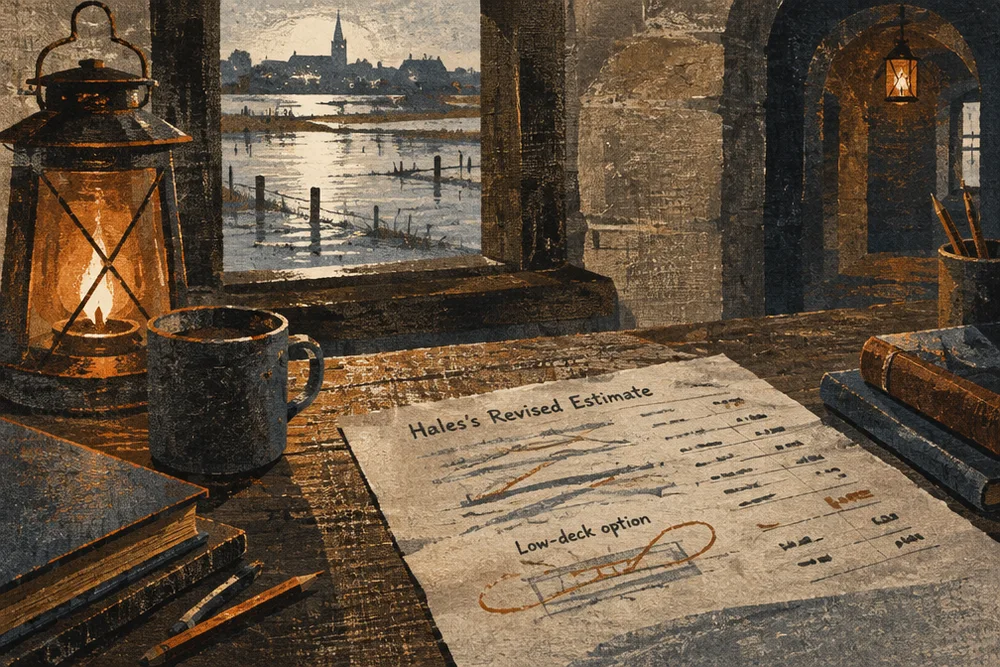
Catrin felt the term dates like a pressure under her ribs. Nell had already lost lessons to the mill’s demands. Other children had been kept home for weather and distance. A later bridge would not be a small inconvenience. But a low bridge that closed in ordinary winter water would make the delay repeat itself, year after year.
“How much later?” she asked.
Hales named a week in October, with the warning that a hard spell could move it further.
Agnes came to the schoolroom that afternoon. She read the estimate in silence, turning the page once to check the staged payments. Catrin stood beside the desk, one hand resting on its edge. A row of children copied sums behind them; their pencils made a soft, uneven scratch.
“The subscription balance will not carry this today,” Agnes said.
“Some pledges are due at harvest.”
“And the timber pledge is in the total?”
“It is, at the value Hales allows. He says it can serve the rail and part of the deck.”
Agnes took off her gloves and placed them together. “Then there is a risk. Not a dishonest one, but a real one. If the timber proves unsuitable, we must find money or stop the work.”