Supper Before the Footbridge
Page 155 of 204
Chapters
“Agnes refused.”
“I refused first.”
“Yes.” Catrin’s eyes did not leave her face. “You did.”
There was a warmth in the schoolroom from the small fire, but Fenella still felt the cold at her back. She had never thought of herself as brave. She had thought of the room full of eyes, the money waiting to be divided, and the prospect of people believing she had cost them their relief. She had said no because the requested sentence was not true in the way the paper required. That was all. It did not lessen the cost.
“Do you think the bridge will be built?” she asked.
“I think it has a chance now.”
“A chance is not a bridge.”
“No,” Catrin said. “It isn’t.”
She did not dress hope up as a promise. Fenella liked her better for that.
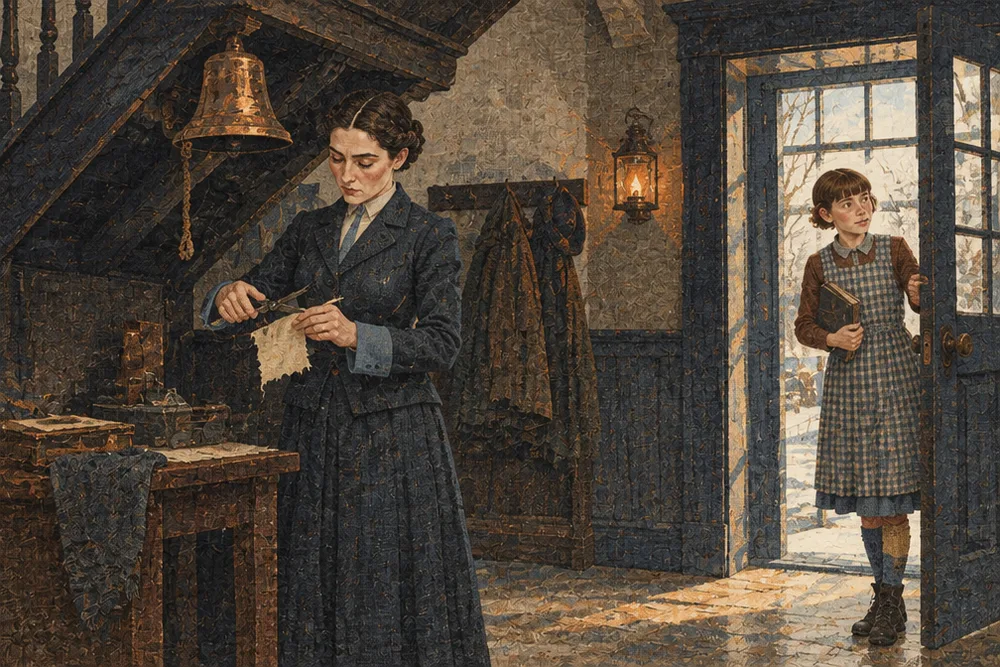
At the door, Fenella glanced toward the stairhead where the warning bell hung. It was a plain iron bell, its rope worn shiny where fingers had pulled it. Nothing in the hearing had shown that the bell’s single stroke could tell anyone whether the ferry was still in service. The lantern was a household signal, made by custom and habit, not by an agreed rule. She had not understood the difference until Catrin asked what each person had actually seen.
“You kept the accounts separate,” Fenella said.
“I tried to keep the words separate from what anyone wanted them to mean.”
Fenella pulled her shawl closer. “Keep doing that.”
Catrin’s chin rose slightly. “I mean to.”
She left the schoolroom with the purse in her pocket and the pencilled freight terms still creased in her hand. The deed was signed, the bridge not yet built, the river unchanged. But one boundary had been drawn in ink, and another, between what could be proved and what could only be remembered, had not been crossed.
On Saturday, the sacks of meal arrived first, borne on a low cart from the mill. Two men rolled them down the bank, their boots slipping where mud had dried over the stones. The iron crate followed, chained to the cart bed. Fenella stood by the landing with her shawl pinned at the throat and a small board propped against the wall: FREIGHT CROSSING—TEN O’CLOCK.
The tide was on its way in. The boat rose gently against its mooring, the chain clicking now and then against the ring. Edwin came late enough to make Fenella look at the clock twice, but not late enough to lose the booking. He brought a second man to help load and a folded sheet bearing the inspector’s mark.