Supper Before the Footbridge
Page 146 of 204
Chapters
Agnes Bellord had spread the agreement across a desk at the front of the room. Her plum wool dress made a solid block of colour against the bare wall; her flat black hat sat beside an open ledger. Catrin Rowse stood by the window with her long hands folded at her square cuffs. Ivo Marr leaned over the back of a bench, his iron-grey head bent as if he were measuring a timber by eye.
“The written terms are these,” Agnes said. “A public footway from the west bank across the old mill abutment. The eastern approach to run through a fenced strip in the yard. The mill will grant the land in perpetuity. The parish will pay for the fence and keep the way clear. No gate, no toll, and no right to close the approach.”
“Provided carts can pass without obstruction,” Ivo said. His forward stoop made him seem to speak into the page. “The way must not cut off the yard.”
“The strip is wide enough for the footway,” said Catrin. “The carts have their own turn.”
“When the yard is clear,” Ivo answered. “It is not always clear.”
Agnes held up a hand. “That is why we are here. The mill has agreed to give the strip, but not to accept liability for accidents caused by the passage. The parish accepts upkeep. The contract is drawn on that basis.”
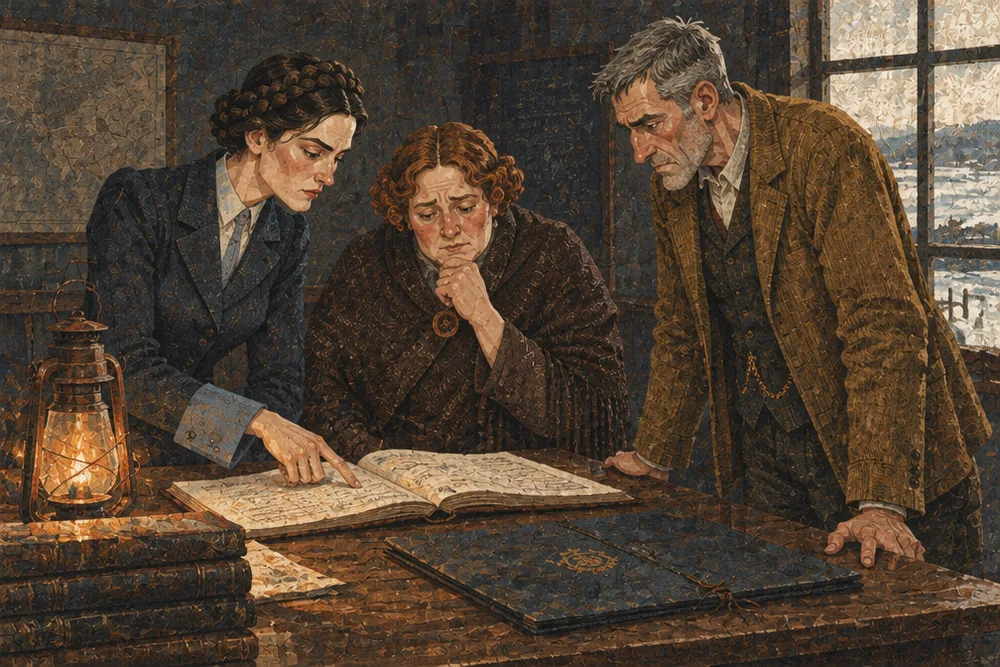
Fenella followed the narrow lines with one finger. At the lower corner a space waited for the mill’s seal, another for the commissioners, and a third for witnesses to the boundary. Nothing there spoke of the man who had once taken the ferry across a flooded lane, or the lantern she had put out in the kitchen window. The paper offered a way forward, but it had not yet named the price hidden in its margins.
“Read it from the beginning,” Fenella said. “And read every line that asks me to put my name to anything.”
Agnes read the clauses aloud, stopping at each numbered paragraph while Catrin tracked the place with a blunt pencil. The land strip began at the eastern end of the abutment, crossed a corner of the mill yard, and joined the public lane beyond the pay shed. A fence would keep children clear of the loaded carts. The mill would retain the yard and its working entrance; the footway would be open at all hours.
“There’s no gate?” Fenella asked.
“No gate,” said Agnes. “That was a condition of holding the relief balance for the bridge.”