Supper Before the Footbridge
Page 14 of 204
Chapters
The second woman came that afternoon. Jane Rusk’s husband had been working at the mill’s wheel when a belt slipped and took two fingers from his right hand. He was alive, but the foreman had put him off until he could manage a tool again. Jane brought a folded notice from the parish office and asked if Fenella had a spare blanket. Fenella had one, but it was patched thin at the middle; she gave it anyway.
“They told us there might be household relief,” Jane said. “But if they put the whole subscription into a bridge, there’ll be nothing left for us.”
“They won’t decide that without hearing the accounts.”
“What account can a woman give?” Jane asked, then seemed to regret it. “I don’t mean you should lie. I mean they’ll take one sentence and make it carry more than it can.”
Fenella looked at the kettle’s blackened base. She had heard people repeat that the lantern went out before the bell, or after it, as if a certain order could make a man return. “I’ll say what I saw,” she told her.
Jane held the blanket folded over her arm. “And what did you see?”
Fenella turned the kettle by its handle, though it was already off the fire. “I saw the boat moored. I saw the lane under water. I heard the bell once. I saw the ferry lantern go dark.”
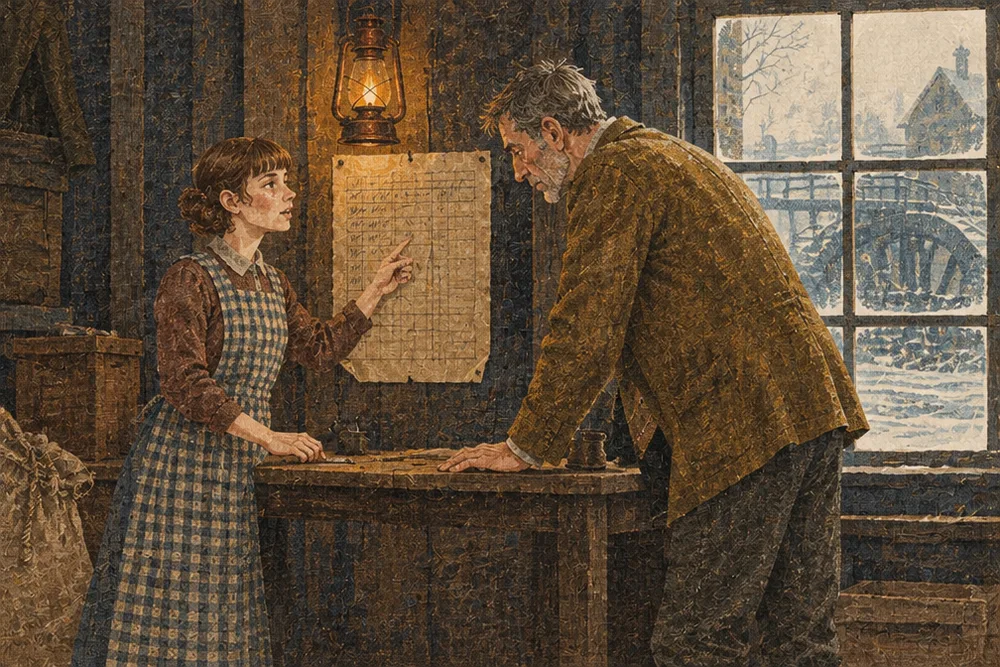
“In that order?”
“I saw the lantern from my kitchen. I heard the bell from the quay. I did not see the bell rope.”
Jane nodded slowly, as if Fenella had given her a thing she could carry but not use. “They’ll ask you to choose.”
“Then they’ll ask for more than I have.”
After Jane left, Fenella took down her husband’s old ledger from the shelf. It had once held ferry fares and the names of people who crossed on credit. His writing slanted uphill. On the last page, a short list of household errands ended with the word supper, written in the margin beside the date of the flood. She closed the book without touching the page.
The next morning, she went to the mill to ask for the coal measure’s price from Edwin. The lane had dried to ridges of mud, but the low places held water, and her shoes sank at the edges. At the pay shed she found Ivo Marr with a tally sheet pinned under one hand. His iron-grey hair was clipped close, and he bent over the page with the forward stoop of a man accustomed to speaking through machinery.