Supper Before the Footbridge
Page 134 of 204
Chapters
Catrin thought of the pupils whose names had vanished from the attendance book as their families found other work for them. She thought of Nell’s slate, carried back from the far bank by a mill delivery, its sums blurred where rain had caught the chalk. ‘No,’ she said. ‘We don’t.’
The agreement between them was not a promise, but it was enough to keep the question alive. Agnes asked for the written estimate as soon as it was ready. Mr. Pelling, on his way out, said he would not oppose a fenced strip provided the cost did not exceed the present balance. He had not promised the balance would stretch, and Catrin did not ask him to pretend otherwise.
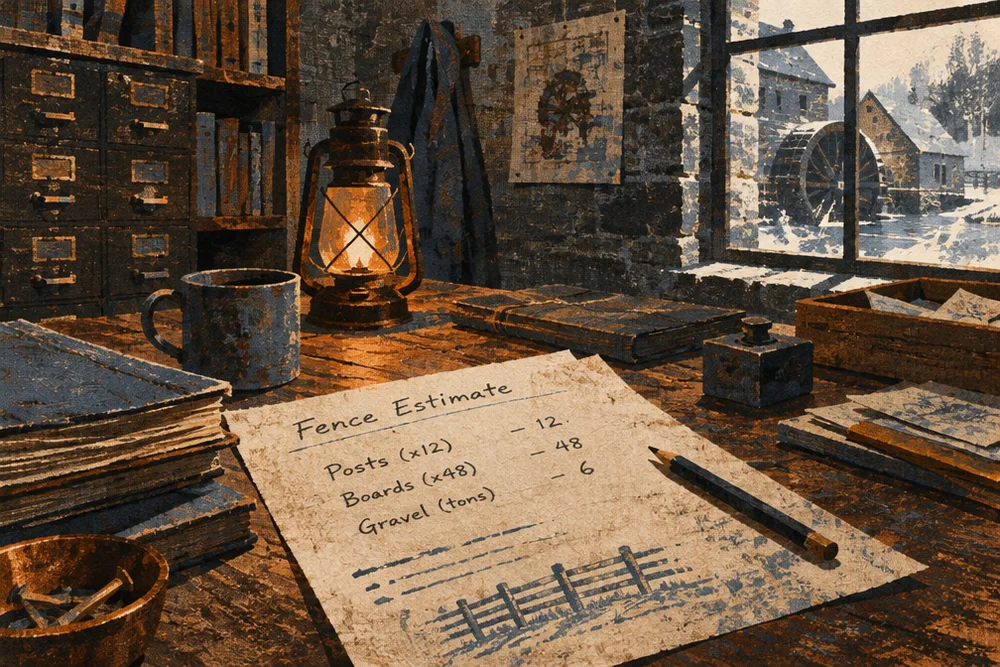
Ivo’s figures arrived the following afternoon. He had written them in a workman’s square hand, listing the length of fencing, the heavier posts needed near the cart turn, the boards that would protect sleeves and fingers, and the gravel required at the lane. He had included a warning: the drain must be cleared before construction, and the fence checked after each hard flood. There was no neat total at the bottom. Instead he had given a range, with labor priced separately from materials.
Catrin read the paper in the schoolroom, then compared each item with the storekeeper’s prices. Even the lower figure left almost no room for error. If the drain required new stonework, they would be short. If the fence were built too lightly, a cart could break through. If they diverted the route again, the bridge bid would need revising, and the relief balance might be lost while the commissioners examined it.
She carried the estimate to the mill office. Ivo was there, standing at a desk covered with orders. He looked up as she placed the sheet before him.
‘You made the posts dearer than I expected.’
‘The yard has taught me what a post has to bear.’
‘And the gravel?’
‘The lane is wet. You walked it.’
‘I did.’
‘Then you know.’
She had no answer to that which did not sound like bargaining. She studied the figures again. The estimate was not a bid, and the mill had not offered to supply materials cheaply. It was simply the best account of what the passage would require, given the place and the carts that used it.
‘Could we use fewer boards?’
‘You can use fewer boards.’
‘Would you?’
‘Not if my own daughter had to walk there.’