Supper Before the Footbridge
Page 104 of 204
Chapters
Catrin waited. She knew Agnes was not praising her. The committee had no new money to spend, and the emergency subscription might be needed for another household before the month was over. A bridge would require a new estimate and fresh pledges. The first bid had already lapsed when the hearing closed without a finding of duty. The route Catrin wanted might prove too costly. The mill might insist on controlling the eastern approach. There was no promise in the figures she had brought.
“Will you ask the committee to reconsider?” she said.
“When we have the estimate.”
“And if it is higher than the old one?”
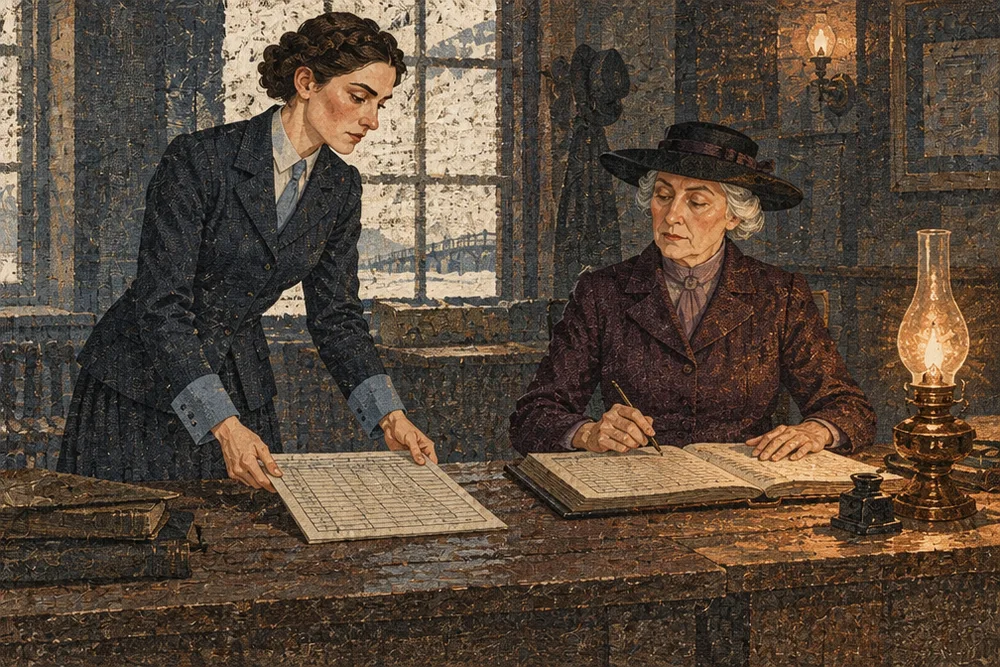
“We shall see what the village is prepared to pay.” Agnes folded the paper, then unfolded it again. “You must understand, Mistress Rowse, that a school need is not made less urgent by being separated from a death. But it is made harder to finance.”
“I understand.”
“Do you?”
Catrin thought of the unfinished hearing record, of the words she had copied without smoothing their edges. She thought of Nell’s empty place, the fare book’s neat sums, the flooded lane and the six miles to the road bridge. “I would rather make a harder case we can stand by than an easier one that depends on a finding we do not have.”
Agnes studied her, then drew a short line beneath the total at the foot of the table. “That will do for the next meeting.”
Catrin gathered her papers. At the window, the darkness had gathered over the river. She could see no lantern on the far bank from this angle, only a pale blur where the mill yard met the water. The warning bell was silent. Nothing in the night could tell her whether a crossing would be built by summer, or whether Nell would still have time for lessons when it was. But the next committee meeting had a date; the surveyor would come after the spring tides; and the proposal would be judged by what children needed now, not by a certainty no witness could supply.
She walked back to the schoolroom and laid the papers in the locked drawer beneath the register. The route and the figures would be there in the morning, ready to be read without alteration. When she turned the key, she heard the river under the quay stones, moving unseen past the village. She had not found a way to command it. She had found a way to describe what it kept making difficult.